DANCING NEBULA

DANCING NEBULA
When the gods dance...

Saturday, February 2, 2013

As Music Streaming Grows, Royalties Slow To a Trickle

"Late last year, Zoe Keating, an independent musician from Northern California, provided an unusually detailed case in point. In voluminous spreadsheets posted to her Tumblr blog, she revealed the royalties she gets from various services, down to the ten-thousandth of a cent. Even for an under-the-radar artist like Ms. Keating, who describes her style as “avant cello,” the numbers painted a stark picture of what it is like to be a working musician these days. After her songs had been played more than 1.5 million times on Pandora over six months, she earned $1,652.74. On Spotify, 131,000 plays last year netted just $547.71, or an average of 0.42 cent a play. 'In certain types of music, like classical or jazz, we are condemning them to poverty if this is going to be the only way people consume music,' Ms. Keating said. ... The question dogging the music industry is whether these micropayments can add up to anything substantial. 'No artist will be able to survive to be professionals except those who have a significant live business, and that’s very few,' said Hartwig Masuch, chief executive of BMG Rights Management."

~Slashdot~

Your Facebook Profile Could Determine Mental Illness

(Then What?)

Facebook-doctors

Everyone has that one crazy Facebook friend. They overshare, write cryptic statuses or worse, type in all caps.

Those seemingly annoying posts, or lack thereof, could be more than just news feed fodder. Facebook profiles could be used as insight into mental health issues, a new study says.

According to researchers at the University of Missouri, whether you post once an hour or once a month can be an indicator of your psychological state. Researchers surveyed more than 200 college students to gauge their levels of extroversion and support of strange beliefs, then asked participants to print their Facebook activity. Students had the option of blacking out portions of their Timeline.

What they chose to conceal revealed information about their psychological state, study researcher Elizabeth Martin says in a statement.

Some individuals exhibited social anhedonia, a condition characterized by lack of pleasure from communicating and interacting with others. Their symptoms ranged from social withdrawal to odd beliefs, and those same people posted less photos, communicated less frequently via Facebook and had a lower friend count.

Others showed signs of paranoia based on how much information they blacked out on their profile.

The idea for the study came through a conversation between Martin and the second author, Drew Bailey, who doesn't have a Facebook profile. A discussion arose about profile content and its correlation to psychology.

"The Internet is novel way to study human psychology because it can ameliorate some of the self-report biases associated with paper-and-pencil reports," Martin told Mashable in an email. "Because of the real or imagined perception of anonymity, the Internet may allow unique access to the psyche. One’s social networking information can be understood as an example of one’s naturalistic behavior."

Though it's unclear whether or not therapists and psychologists can use social networks for treatment, Martin says the study is a first step to using the information to possibly provide a more complete clinical picture.

What do you think your Facebook profile says about you? Do you believe this may be an effective measure of mental health? Let us know what you think in the comments.

Mashable composite. Photo via iStockphoto, Cimmerian

How Netflix is turning viewers into puppets


"House of Cards" gives viewers exactly what Big Data says we want. This won't end well


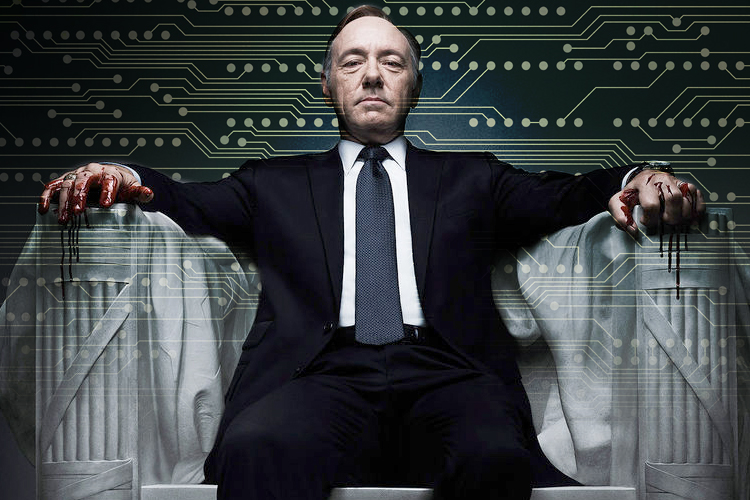
How Netflix is turning viewers into puppets Kevin Spacey in "House of Cards"
This story has been corrected since it was originally published.

I hit the pause button roughly one-third of the way through the first episode of “House of Cards,” the political drama premiering on Netflix Feb. 1. By doing so, I created what is known in the world of Big Data as an “event” — a discrete action that could be logged, recorded and analyzed. Every single day, Netflix, by far the largest provider of commercial streaming video programming in the United States, registers hundreds of millions of such events. As a consequence, the company knows more about our viewing habits than many of us realize. Netflix doesn’t know merely what we’re watching, but when, where and with what kind of device we’re watching. It keeps a record of every time we pause the action — or rewind, or fast-forward — and how many of us abandon a show entirely after watching for a few minutes.

Netflix might not know exactly why I personally hit the pause button — I was checking on my sick son, home from school with the flu — but if enough people pause or rewind or fast-forward at the same place during the same show, the data crunchers can start to make some inferences. Perhaps the action slowed down too much to hold viewer interest — bored now! — or maybe the plot became too convoluted. Or maybe that sex scene was just so hot it had to be watched again. If enough of us never end up restarting the show after taking a break, the inference could be even stronger: maybe the show just sucked.

In 2012, for the first time ever, Americans watched more movies legally delivered via the Internet than on physical formats like Blu-Ray discs or DVDs. The shift signified more than a simple switch in formats; it also marked a major difference in how much information the providers of online programming can gather about our viewing habits. Netflix is at the forefront of this sea change, a pioneer straddling the intersection where Big Data and entertainment media intersect. With “House of Cards,” we’re getting our first real glimpse at what this new world will look like.

For at least a year, Netflix has been explicit about its plans to exploit its Big Data capabilities to influence its programming choices. “House of Cards” is one of the first major test cases of this Big Data-driven creative strategy. For almost a year, Netflix executives have told us that their detailed knowledge of Netflix subscriber viewing preferences clinched their decision to license a remake of the popular and critically well regarded 1990 BBC miniseries. Netflix’s data indicated that the same subscribers who loved the original BBC production also gobbled down movies starring Kevin Spacey or directed by David Fincher. Therefore, concluded Netflix executives, a remake of the BBC drama with Spacey and Fincher attached was a no-brainer, to the point that the company committed $100 million for two 13-episode seasons.

“We know what people watch on Netflix and we’re able with a high degree of confidence to understand how big a likely audience is for a given show based on people’s viewing habits,” Netflix communications director Jonathan Friedland told Wired in November. “We want to continue to have something for everybody. But as time goes on, we get better at selecting what that something for everybody is that gets high engagement.”

The strategy has advantages that go beyond the assumption of built-in popularity. Netflix also believes it can save big on marketing costs because Netflix’s recommendation engine will do all the heavy lifting. Already, Netflix claims that 75 percent of its subscribers are influenced by what Netflix suggests to subscribers that they will like.

“We don’t have to spend millions to get people to tune into this,” Steve Swasey, Netflix’s V.P. of corporate communications, told GigaOm last March. “Through our algorithms we can determine who might be interested in Kevin Spacey or political drama and say to them, ‘You might want to watch this.’”

And maybe we will. Early reviews for “House of Cards” are promising. It will be fascinating to find out how many people gorge themselves on all 13 episodes this upcoming weekend. (Netflix data shows that’s how we like to consume our TV series now — in great gulps and marathons — so that’s how it will give them to us.) But one does end up wondering: What will the Big Data approach mean for the creative process? If Netflix perfects the job of giving us exactly what we want, when and how will we be exposed to things that are new and different, the movies and TV shows we would never imagine we might like unless given the chance? Can the auteur survive in an age when computer algorithms are the ultimate focus group? And just how many political dramas starring Kevin Spacey can we stand, anyway?

The scope of the data collected by Netflix from its 29 million streaming video subscribers is staggering. Every search you make, every positive or negative rating you give to what you just watched, is piped in along with ratings data from third-party providers like Nielsen. Location data, device data, social media references, bookmarks. Every time a viewer logs on he or she needs to be authenticated. Every movie or TV show also has its own associated licensing data. The logistics involved with handling every bit of information generated by Netflix viewers — and making sense of it — are pure geek wizardry.

Netflix doesn’t just know that you are more likely to be watching a thriller on Saturday night than on Monday afternoon, but it also knows what you are more likely to be watching on your tablet as compared to your phone or laptop; or what people in a particular ZIP code like to watch on their tablets on a Sunday afternoon. Netflix even tracks how many people start tuning out when the credits start to roll.

Correlating the raw numbers of Kevin Spacey fans who also like David Fincher and have a fondness for British political dramas is just the beginning. Netflix knows enough about what you are watching to judge specific aspects of content as well. Last summer senior data scientist Mohammad Sabah reported at a conference that Netflix was capturing specific screen shots to analyze in-the-moment viewing habits, and the company was “looking to take into account other characteristics.”

What could those characteristics be? GigaOm’s report of the Sabah presentation speculated that “it could make a lot of sense to consider things such as volume, colors and scenery that might give valuable signals about what viewers like.”

Netflix chief content officer Ted Sarandos has said that all that data means that Netflix has a very “addressable audience.” Unlike the traditional broadcast networks or cable companies, Netflix doesn’t have to rely on shoveling content out into the wild and finding out after the fact what audiences want or don’t want. They believe they already know.

Of course, data-centric decisions don’t guarantee hit-making success. Kevin Spacey’s participation isn’t bulletproof (see “Fred Claus”) and even David Fincher can’t claim a perfect record. (“Alien 3,” anyone?) Netflix’s ambition to challenge HBO as a destination for quality original programming will require fabulous craftsmanship to go along with the Big Data filters. All the Big Data in the world can’t rule out, once and for all, the possibility of a bomb.

But that goes without saying. The interesting and potentially troubling question is how a reliance on Big Data might funnel craftsmanship in particular directions. What happens when directors approach the editing room armed with the knowledge that a certain subset of subscribers are opposed to jump cuts or get off on gruesome torture scenes or just want to see blow jobs. Is that all we’ll be offered? We’ve seen what happens when news publications specialize in just delivering online content that maximizes page views. It isn’t always the most edifying spectacle. Do we really want creative decisions about how a show looks and feels to be made according to an algorithm counting how many times we’ve bailed out of other shows?

For years Netflix has been analyzing what we watched last night to suggest movies or TV shows that we might like to watch tomorrow. Now it is using the same formula to prefabricate its own programming to fit what it thinks we will like. Isn’t the inevitable result of this that the creative impulse gets channeled into a pre-built canal?

It’s certainly possible to overstate the case here. One could argue that Netflix’s strategy is only a slightly more sophisticated version of what’s already been in place for, well, forever. We wouldn’t be seeing teenage vampires or zombies every time we turn on the TV if the money that bankrolls the content creation business hadn’t already decided that’s what we want to see. Actors who have the fortune to appear in hit movies or TV show get more parts to play. So what else is new?

But there’s a level of specificity made possible by Big Data that suggests we’re headed into new territory. “House of Cards” is just one symptom of a society-wide shift. The Obama campaign used the same kind of number crunching to target voters with more accuracy than any political campaign had ever accomplished before. Online advertisers are also gathering vast amounts of detailed information about us from our smartphones, our Facebook likes and our Google searches.

The sheer amount of data available to crunch is already phenomenal and is growing at an extraordinary rate. Last summer, at a panel discussion that included several significant players in the emerging Big Data universe, Michael Karasick, a V.P. at IBM Research, estimated that there is “a thousand exabytes of data on the planet anywhere.” An exabyte is one quintillion bytes, or one billion gigabytes. That’s a lot of ones and zeroes all by itself, but the mind-boggling part of the equation is that Karasick predicted that just two years from now there will be 9,000-10,000 exabytes of data on the planet.

The companies that figure out how to generate intelligence from that data will know more about us than we know ourselves, and will be able to craft techniques that push us toward where they want us to go, rather than where we would go by ourselves if left to our own devices. I’m guessing this will be good for Netflix’s bottom line, but at what point do we go from being happy subscribers, to mindless puppets?

Andrew Leonard

Andrew Leonard is a staff writer at Salon. On Twitter, @koxinga21. 


COMMENT:  I like Netflix and was one of their first customers. I'm not going to argue for or against "Big Data" right now. You youngins have to live in the world you are paying to create with your GPS enabled gadgets and eagerness to give Big Daddy everything he wants. Netflix is a genuine value for me. I don't care what people, especially potential employers, think of me. My viewing habits aren't going to cost me employment. My big problem with Netflix is that I often have to specify which new films I would like to view. There is an assumption that, based on prior viewing habits, I will only be interested in the new movies they present when I click on "New Arrivals." Now, might be that I lost interest in, say, blowjob movies -- yet Netflix keeps pushing them down my throat. Big Daddy doesn't understand change and complexity beyond Idiocracy (on the tube right now).  Henry K

Controversial Sculptures by David Cerny


By Village Mayor • 


Wikipedia: “David Černý (born December 15, 1967 in Prague) is a Czech sculptor whose works can be seen in many locations in Prague. His works tend to be controversial. He gained notoriety in 1991 by painting a Soviet tank pink that served as a war memorial in central Prague. As the Monument to Soviet tank crews was still a national cultural monument at that time, his act of civil disobedience was considered “hooliganism” and he was briefly arrested.”

He also has a very bizarre website http://www.davidcerny.cz/). Well, happy viewing, and of course don’t forget to comment.

P.S.: if you decide to use our content on your blog or website, don’t forget that you are allowed to use only a very small portion of a post and don’t forget to link to the source: http://villageofjoy.com/controversial-art-by-david-cerny/

Permanent Installation at FUTURA Gallery Prague

info: you climb a ladder and stick your head in the sculpture’s arse to see a video of two Czech politicians feeding each other slop to a soundtrack of ‘We are the Champions

year: 2003

material : mixed media

height 5.2 m (17.06 ft)

address: Holečkova 49, Prague 5, Czech Republic

“Nation for Itself Forever” (Narod sobe navzdy)

(Image credits: http://www.davidcerny.cz via boredpanda)

year: 2002

height: 10 meters high (32.81 ft) (somehow hard to believe, maybe the statue itself hangs in such height, correct me if I’m wrong)

more: to keep the statue it has been changed more or less due to fear of protests that the project is aimed at National Theater itself.

Two Proposals to Outdoor Metro Tunnel

First proposal

(Image credits: http://www.davidcerny.cz via boredpanda)

Second proposal

(Image credits: http://www.davidcerny.cz via boredpanda)

station: Butovická

info: in this moment the development of the project is very uncertain

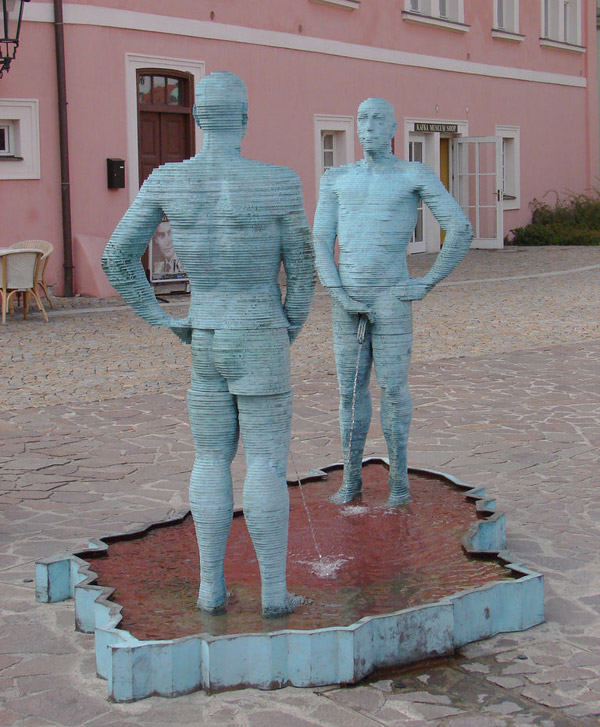
Two Peeing Guys (Sculpture)

(Image credits: Chaymation via boredpanda)


(image credits: Irwin)

info: ”The idea is disarmingly simple. Two bronze sculptures pee into their oddly-shaped enclosure.

While they are peeing, the two figures move realistically. An electric mechanism driven by a couple of microprocessors swivels the upper part of the body, while the penis goes up and down. The stream of water writes quotes from famous Prague residents.

Visitor can interrupt them by sending SMS message from mobile phone to a number, displayed next to the sculptures. The living statue then ‘writes’ the text of the message, before carrying on as before.” – Chaymation

year: 2004

height: 210cm (6.89ft)

address: Prague, Czech Republic

Embryo (Installation)

(Image credits: pavel-helge.dk, his website: pavel-helge.dk via boredpanda)

year: 1996

materiál : metal, foam, LED

height: 120 cm (3.94ft)

address: Czech Republic, Prague 1, Namesti U Sv. Anny, close to the Charles bridge in Stare Mesto

Car with Legs (Sculpture)

(image credits: leonbarnard via boredpanda)

Svaty Vaclav (Sculpture)

(Image credits: jp1958 via boredpanda)

Lucerna Palace’s central atrium is dominated by Czech sculptor David Černý’s dead horse ridden by St. Wenceslas. It is supposed to be an ironic twist on the St. Wenceslas statute in the square outside.

address: Wenceslas Square, Prague, Czech Republic

“Hanging out”

(Image credits: Curious Expeditions via boredpanda)

(Image credits ahisgett via boredpanda)

info: this sculpture, more often referred to as the Hanging man was first exhibited at the exhibition “Respekt 97” at the Villa Richter in the Prague’s Lesser Town. Later installed at the Czech Cultural Center in Berlin; Moderna Muset in Stockholm; National Theatre in London; and the Embassy of the Czech Republic in London.

year: 1996.

dimensions: 233 x 60 x 45 cm (7.64 x 1.96 x 1.48 ft)

Zhizhkov TV Tower with Crawling Babies

(Image credits: laura padgett via boredpanda)

(Image credits: CREAMASTER via boredpanda)

Žižkov television tower is the highest tower in the Czech Republic, it was completed in 1992 and hosts an observation point, a restaurant and a TV transmitter.

AMBITION

https://blogger.googleusercontent.com/img/b/R29vZ2xl/AVvXsEhAc5j8TAvLAmbQKv-w3YzaGbKsYFitT-BWhXlm5M5lEDkApX1ZeY4_4sN7sGMp4Nmdx6FEjgrtpM9a7kkccjMesS5FsJgFnelxiP-VoWbWQVhgnPoLzl4it8LB8iORh0nxAsWzrUHkus5w/s1600/ambition1-blog.jpg

https://blogger.googleusercontent.com/img/b/R29vZ2xl/AVvXsEhgi_zvGoEsSMW37YdGog5D1nZZvLeiwmqFxaxEasA8i7AqIdiU_-k7h2blnJdsaJqsS4ALI10zKmXL4yfBWg_uvpXcHLlzOr_0OBSqbXZ8fCn4BIf6WFDDtQ-j2if7Sp0Trpb3C0NpD4KU/s1600/ambition2-blog.jpg

Friday, February 1, 2013

DIGITAL MUSIC NEWS

January Digital Music Sales Posted 10% Increase Vs. Last Year


447
U.S. digital sales appear to be maintaining strength even after the redemption of gift cards consumers received in their Christmas stockings last month. Nielsen SoundScan reported this week that, boosted primarily by strong digital album sales, track equivalent album (TEA) sales are up 14% in January vs. the same month in 2012. As reported by Billboard, track sales were up 5.4% the first week of the year but were up only 0.9% the following week. It appears gift card balances had run out by the third week as sales were down 0.9% over the same week in 2012. But music buyers returned to the virtual store last week, as sales increased 2.7% vs. January '11, bringing the four-week sales increase to 3.3%. 
Sales of digital albums showed a somewhat different trend: following a robust 25.6% year-over-year increase in the first week of January, digital album sales cooled a bit, with sales gains of 12.2%, 15.5%, and 10.1% in the following three weeks. Digital album sales were up 19.3% in the first four weeks of the year but, if the first week of the month is subtracted, sales increased 12.6% - less than two percentage points below the 14.2% gain digital albums posted in all of 2012. [Full story: Billboard]
MIDEM Report: Digital Is Driving Music Industry On Road To Recovery


571
Remember all that gloom and doom you heard over the past decade about the demise of the recorded music industry? Well, you can file it away with Mayan calendar predictions, according to Frances Moore, CEO of the International Federation of the Phonographic Industry (IFPI), the group that represents the interests of the international recording industry. "We can now say that the music industry globally is on the road to recovery and heading for growth for the first time since 1999," Moore told the audience at MIDEM in Cannes last week. "We may not get there this year, but the direction of travel is clear." Noting that all digital revenue streams, including music downloads, subscriptions, and other channels are growing, he urged further protection of all copyright laws worldwide. "Download and subscription services are growing fast, driven by smartphones and tablets," added Edgar Berger, president/CEO International of Sony Music entertainment. "I'm extremely confident about the future development of the recorded music industry going into 2013." And MIDEM Director Bruno Crolot explained that digital music is growing in a way that it's now starting to cover the losses and decline in physical sales. "Even if it's a bit slow and a bit fragile, it's a real trend in the U.S. and we hope this will also come to other countries in Europe and the rest of the world," he said. [Full story: GMA News]
Indies Claim MySpace Won't Negotiate, Could Force "Take-Downs"


572
As the new MySpace attempts to re-brand itself as the online source for digital music, many independent record labels reportedly are fuming that the company appears to be interested in negotiating licenses only with the major labels. According to Digital Music News (no connection with this newsletter), a number of indies met with the media at MIDEM last week to protest the fact that the MySpace website is loaded with music from independent artists and producers, but the company has made no good-faith effort to license it. Of course, MySpace has the right to feature whatever music, labels, and artists it wants, but the indies are irritated because, instead of pursuing licensing for independent content, the company appears to have decided to force labels to pursue Digital Millennium Copyright Act (DMCA) takedown notices to remove their content. "I was just in shock over this," said Daniel Glass, owner of Glassnote Records (Mumford & Sons, Phoenix, Childish Gambino, etc.) "This is a bad one. [And] we're going to start issuing takedowns." While Association of Independent Music (AIM) President Alison Wenham told DMN that indies aren't interested in drowning MySpace in a deluge of takedowns, she did indicate that it's a tactic that might become necessary in order for indies to gain some respect - and space at the bargaining table. [Full story: Digital Music News]
  
Megaupload Shutdown Led To Increase In Legal Digital Sales


510
"The shutdown of Megaupload caused a statistically significant increase in digital sales." That's the claim made last week by Michael Smith, professor of information technology and marketing at Carnegie Mellon University, who told an audience at the annual Digital Book World Conference in New York that every 1% reduction in Megaupload usage translated to a 2.6%-4.1% increase in digital sales. While Smith did acknowledge that Megaupload had higher usage than other digital content sales sites, he pointed out that, "It does suggest that when you look at competing with free, using anti-piracy measures to make piracy less attractive does work." Using NBC-TV as an example, Smith observed that in 2007 the network removed its content from iTunes after a fight with Apple. After doing do, piracy of NBC shows increased. In fact, piracy increased 11% for NBC titles, while ABC, CBS, and FOX also saw increases in their content being pirated. "When people couldn't find it in iTunes anymore they went to piracy," he concluded. "There was also a negative spillover effect for the industry because people learned how to pirate." [Full story: Media Bistro]
Samsung Planning To Expand Music Hub Across All Platforms, Devices


522
According to Nielsen's "2012 Music Industry Report," digital track sales increased 5% in 2012 vs. the prior year, while the sales of digital albums jumped 14.1% during the same period - a fact that is not going unnoticed at Samsung's headquarters in South Korea. In a recent interview with The Next Web, Samsung's SVP TJ Kang said the company is expanding its Music Hub service, which currently is available on Galaxy S III and Galaxy Note II, across its entire portfolio of devices, including mobile devices, computers, televisions, and appliances. The cloud-based Music Hub offers online traditional music store purchases, as well as radio streaming and other streaming services, and cloud-locker services, making it much more accessible than Apple's closed iTunes platform. Samsung's end goal is to offer it as a service similar to Amazon MP3 and Amazon Cloud Player, although acquiring licenses from record labels will be no easy feat and will no doubt require significant patience. The bottom line, according to analysts close to the company, is that as Samsung overtakes Apple in smartphone shipments, the Korean giant has all the momentum to make Music Hub a dominant player in the digital music space. [Full story: Phone Dog]
Tom Silverman: Music Industry Can Hit $100 B Annually In 10 Years


573
Despite a decade of declining sales and revenues, and the shrinkage of labels' artist rosters, the global music industry - if guided properly - can hit $100 billion in annual retail revenue in ten years. That's the optimistic prediction of Tommy Boy Entertainment founder Tom Silverman (left), who last week predicted in a Billboard guest editorial that the only way to attract more investment into more artists and create more music jobs is to increase the revenues of the music business. "We used to think the only way to do that was to sell more albums and sell them at a higher price," Silverman wrote. "Digital albums will continue to grow and will pass physical CDs in 2015 in unit sales, but gains in digital sales will continue to be erased by declines in physical sales." The solution: maximize virtually every revenue conduit available to the music industry by embracing non-sales revenue opportunities. "It will take an organized effort by the music industry and our technology, device and mobile service providers to make this dream a reality, but we made just such an effort in the early '80s when we launched the CD," he said. "There are only an estimated 300 million music buyers in a world of 7 billion people. There are 6 billion active cell phones and 1.2 billion smartphones. Fifty million new cars hit the roads every year...The music industry must focus its efforts on developing a new paradigm for music revenue creation." [Full story: Billboard]
Al Bell Presents American Soul Music ... And American Soul TV

2
If you're into classic and contemporary Soul, R&B, Blues, Gospel, Jazz, Hip-Hop Soul, Rap Soul, and Neo-Soul, we invite you to listen to Al Bell Presents American Soul Music. Former Stax Records owner and Motown Records Group President Al Bell personally has programmed this awesome radio station online, presenting your favorites from the 1960s and '70s [and some '80s], a lot of the best new music that's being released today, and some real gems you haven't heard in a long, long time. Come to www.AlBellPresents.Com
 and hear it for yourself!

Vine: The future of sex?

It's easy to imagine how the micro-video app could change sexting and amateur porn
  • Vine: The future of sex?

As Twitter’s new video-sharing app battles the inevitable proliferation of porn, I can’t help wondering what Vine could mean for the future of sexting and amateur smut. (I mean, aside from the prospect of an annoying new portmanteau to describe the act of digitally sharing naked media.) This question is admittedly a bit premature — Vine, which limits clips to six seconds, doesn’t offer a way to privately and directly share videos — but it’s easy to imagine such a development, if not on the part of the app’s makers than by some enterprising tech vulture. And while the app has begun blocking searches for terms like “sex” and “NSFW,” presumably to avoid violating Apple’s puritanical standards, loads of X-rated material is still available; it’s just harder to find. (One must know which accounts to follow, or get creative with keyword and username searches.) There’s already at least one independent NSFW site compiling naughty vines, and the app’s only been around for a few days.

What makes me ask the question isn’t the fact that users are already using the app for sexual ends — that happens with virtually all new technology — but rather that it hits the sexual sweet spot of our time. Just last month, I wrote about the rise of GIF porn. At the time, I said, “It should come as no surprise, I suppose, that as our thoughts are distilled into 140 characters, our porn is similarly reduced to 256 colors.” Porno-GIFs are more interesting than a photo but require less time investment than a video — and Vine porn only improves upon that formula, better satisfying our desire for high stimulation with low commitment. It’s also way easier to make than a GIF; and it combines recent trends in porn (amateur porn, gonzo clips, tube sites) with the increasing insta-broadcast of every single thing in our lives.

Of course, Vine didn’t invent the six-second video, but neither did Twitter invent sentences of 140 characters. The app simply provides the tools for creating and sharing such videos; make it and they will, ahem, come. As NSFWVine.com has already shown, if the official app isn’t willing to cater to people’s pervy desires, someone else out there will be. The same is true for the ability to easily record and share such video clips privately à la Snapchat (and you thought underage sexting was scandalous). We could be on the verge of a whole new generation of sex scandals. Just imagine if Anthony Weiner had had access to Vine in 2011! On the other hand, picture the Screech sex tape being reduced to a more bearable six seconds. (You lose some, you win some.) Then again, Vine could easily snap from the weight of excessive hype — after all, I can’t predict the future (if I could, I’d be sitting on a private beach purchased with my Silicon Valley billions). But here’s what I know for sure: Technology is going to keep on revolutionizing sex — from how we meet to how we get off — and watching that happen is going to be more exciting than any six-second clip.
Tracy Clark-Flory

Tracy Clark-Flory is a staff writer at Salon. Follow @tracyclarkflory on Twitter and Facebook.