DANCING NEBULA

DANCING NEBULA
When the gods dance...
Showing posts with label Bad business. Show all posts

Saturday, March 30, 2013

Your iPhone kills jobs


Smartphone apps have created a new digital underclass of low-paid and highly monitored workers. We're all to blame

BY A.M. GITTLITZ

Your iPhone kills jobs

Joseph Gordon-Levitt as a bike messenger in "Premium Rush." (Credit: Columbia Pictures)

This is the sixth and final installment in a new series called Working Ahead, which will examine key issues facing the modern American worker, and how we can use our everyday spending habits to help save and create good jobs. The series is brought to you by the AFL-CIO. To read the other stories in this series, click here.

Today, workers trying to eat cheap at lunch order dollar pizza slices. But a few decades ago, they might have dined at an automat —  cafeterias with rows of coin-operated food displays between the dining room and kitchen. Meals were cheap, usually a nickel.

The customers saved, but the workers paid. Behind the glass, cooks and dishwashers often had to work 12-hour shifts at below average wages. Tensions simmered until 1937, when several shops representing anywhere between 500 and more than 1,000 workers lined up behind the AFL-CIO and won a unionization vote.

The automat workers faced a lot of the same challenges as other service workers at the time, but with one major spin: total invisibility. Without a front-of-house, the automat workers became unsympathetic toilers, not unlike the wretched underclass portrayed in Fritz Lang’s film “Metropolis.”

The modern equivalent of the automat worker is on your smartphone. While there have been many reports on the often miserable working conditions at the Foxconn plant in Shenzhen, China, which manufactures iPhones, it’s easy to see the convenient smartphone apps as labor savers for us. But another layer of the smart technology’s impact on labor has rarely been discussed: the way certain applications have revolutionized domestic labor — especially in the service sector — and how the workers toiling behind the slick interface of a shopping app are not unlike the hidden short-order cook of an automat.

Can’t live with ‘em                   

I know firsthand how rapid the change has been. Before I went to university I worked for a year running food deliveries for a cafe in New York. It was a grueling job, but working in a Brooklyn neighborhood that caters to many sympathetic service employees, the tips were usually pretty high. Three years later, I came back to the same job with an updated résumé that listed “B.A. in Literary Studies” among my qualifications. Much of the staff, the menu and the management was the same. The main difference was the delivery system, a majority of orders now made through Seamless Web or Grubhub.

The job, which I could once recall nostalgically as akin to the friendly neighborhood milkman (instead doling out cheeseburgers and chicken wings), had now become practically bureaucratic. A page would be faxed to the company with the order. Everything was prepaid, including the tip.

The result was much higher volume, so much that a second delivery rider and a dispatcher were hired for each night shift. Another result: Tips were far down. It was much easier for customers to give the recommended $2 tip on any order with Seamless or a flat 10 percent with Grubhub than to give the same low tip in cash when face-to-face with their delivery person.

Having one’s food delivered as opposed to dining in is already one step removed from human contact. From the other end of the phone line, one cannot see the momentary conditions of the restaurant: how busy the floor, how backed up the kitchen, or how close they are to closing. The Seamless and Grubhub apps wipe out the human contact entirely. Ten orders could (and sometimes did) come in at once, and we could not warn the customer of a long wait. If it’s raining heavily, customers will almost never adjust their tips accordingly — seven times out of 10, they stick with the app-recommended $2.

The same principle applies to retail shops. Apps like Snaptell or Redlaser allow users to take photos of bar codes or covers of books, CDs or video games and display reviews and lowest prices. While this practice might not bother major retailers like Barnes and Noble or Best Buy, who have their own massive online stores, smaller shops are finding the practice to be quite predatory.

Troy Swain, co-owner of the New York-based used bookshop Bookthug Nation, has “several people a day” checking prices of books online to see if they can get it cheaper or make a profit reselling them. Some of them scan bar codes using an app. “We kick people out who do that,” he says. “But lots check prices online.”

But with online and app-based shopping, even big box stores like Wal-Mart look like a mom-and-pop in comparison to the vast, sterile warehouses where Amazon’s products are stocked and distributed. In 2011, a report by a paper in Lehigh, Penn., about the working conditions in Amazon’s nearby distribution center found dangerous work conditions caused by high workloads, dangerously high temperatures and mandatory overtime. As most of the employees at the facility were temps, inability to deal with the workload or complaints to management would simply mean dismissal. Similar conditions have recently been reported at an Amazon distribution center in Bad Hersfeld, Germany, where some 10,000 foreign guest workers are strictly disciplined by a private security team that a public television report revealed as a neo-Nazi organization.

Amazon isn’t alone. Disputes over labor conditions have plagued online-oriented businesses such as FreshDirect, WalMart.com and Target, while better working conditions are reported at Zappos.

Compare this to the recent labor situation at the Strand, New York’s iconic used bookstore, which has been unionized since 1976. When management tried to break the union by implementing a two-tier wage system, the workers pressured management into concessions by handing out comics explaining their situation to customers and holding a public action on May Day of last year. The same sort action is much more difficult for an employee of Amazon or FreshDirect. Like the sandwich makers behind the windows of an automat, their work goes largely unseen.

Can’t live without them

Like teenagers who enjoy the social benefits of a mobile phone but rue their parent’s newfound ability to contact them at any time, workers who perform their tasks on-the-go can now be monitored step-by-step by their managers with the help of smartphone applications.

The frustrations of being on the back end of an app is becoming a universal trend in the service industry. I talked to a dog walker named Rod whose job has recently become integrated with smartphone apps.

“A few months ago the company I work for started using an app that requires walkers to scan a QR code each time they enter and leave a client’s apartment. The app basically tracks two things: the duration of the walk (down to the second), and the route. The latter is tracked via your phone’s GPS, and is visible to both the employer and the client.”

The new system has some advantages, such as assurance to the employer and client of not being hustled by employees — and occasionally more time billed per walk. The disadvantages, however, are myriad. Bad reception in buildings, cranky doormen, or faulty keys can set a walker behind on their tightly computerized schedule. Even the dogs are annoyed by this new system, Rod says, “The dog has no idea why I won’t just leave it in peace. An extra five minutes means nothing to a dog, but everything to the app.”

I heard one story of a postal employee who had to scan QR codes to prove he was working the right amount of hours in day. He beat the system by taking photos of the bar codes and scanning those on his smartphone, allowing him to complete tasks at his own rapid pace and then do what he wished with the rest of the day. He was fired, the story goes, for “theft of time.”

For commercial drivers, like moving-company driver Joseph Frey, the smartphone, which he had to purchase independently, had become a costly but necessary expense. The GPS was indispensable enough, but Joseph recounts how being “the guy with the smartphone” actually extended his hours throughout the night. “I was required to edit the schedule all day on my new work phone. I fielded a lot of calls, late night, like 11 and 12 o’clock, waking me up, from guys who didn’t have the Internet and needed their schedule for the next day.”

Another trend in the new smart-workforce are micro-tasking apps likeTaskRabbit, GigWalk or NeighborFavor. Users are able to request a variety of odd jobs and errands that can be assigned to a database of mobile workers with flexible schedules.

A short-lived employee of the household cleaning-centered micro-task app called I Am Exec, who wished to remain anonymous, describes how the smartphone became like a boss in her pocket. “Part of the application process involves watching their ‘training videos’ online where they talk about the different apps you’ll use. One is the app they use to have you check in and out of a job. Each morning they email you who you’re paired with for the day for cleaning, where you’re working, and when your breaks are scheduled.”

The length of cleaning tasks were set over the phone, and if that task ended up taking more time than requested it could be difficult to get extra compensation.  Her entire time at the company, she never met a manager. This was a privilege apparently reserved for employees who move on “to the next phase.”

Even payment was made through an app called Dwolla. Unlike other cleaning agencies, I Am Exec’s employees are trained to refuse tips.

One of the more popular new micro-tasking companies is  eBay’s new Same-Day P2P service, which actually issues a smartphone to new employees. The workers are paid an hourly flat rate as long as they accept a certain number of jobs per week. The phones monitor their location; they need to stay in delivery range and in Manhattan. When a job becomes available, it pops up like a text message. Most of the time, says eBay P2P employee Samuel Littlefield, is spent bumming around and waiting for a gig, often browsing the Internet on his company-issued smartphone.

All in all, he says it’s “like any service industry job. You paste on a plastic smile and do your work as efficiently as possible.”

This type of job is appealing to the same types as freelance writers and graphic designers — young students or recent college grads who either have unpaid jobs as interns or are unemployed, and spend their days bumming around coffee shops trying to figure out where their rent will come from. A recent study by Mohamed Musthag and Deepak Ganesan at the University of Massachusetts  found that the vast majority of micro-taskers — up to 75 percent — are in this age group. These are also the highest-performing micro-taskers, super-agentsas Mushtag and Gensan call them, clever at minimizing transportation costs and content with a temporary low-income job and no benefits.

Another important skill these youths do have is tech-savviness. They are much quicker at adapting to new technology than previous generations, and often already have a smart device in order to socialize. In this sense, many young smart-workers may enjoy the convenience and flexible hours of working via smartphone. After all, being offered a moving job at 10:45 a.m. isn’t so different than being texted by a romantic interest saying, “What are you up to?” at 10:45 p.m.. In this sense, the new buzzword FOMO (Fear of Missing Out) refers to partying and employment equally.

Welcoming our new robot overlords?

How can smart-laborers and micro-taskers fight for better working conditions in these rapidly evolving and precarious conditions? Some have suggested Web-oriented protests, like the digital sit-ins to protest tuition hikes in California, or the digital picket line against Huffington Post called by the National Writer’s Guild. While these actions had some, if limited effect, they are nothing compared to the solidarity and obtrusiveness of a physical picket line, something that is not only practically illegal in many places in the United States but now impossible as well for many types of service workers.

The best hope would be a change in the mediums of exchange themselves, something that would take expanded labor consciousness on the part of smartphone shoppers.

Chris Anderson’s popular take on the long-tail theory offers perhaps the best hope for an ethical way forward. Consumers are preferring smaller-batch products from online shops like Etsy or local merchants. North Brooklyn has experienced a boom in artisanal restaurants, craft-beer shops, bakeries and the like.

Some of these locales, such as the collectively run Norbert’s pizza in Bushwick, can appear virtually empty for much of the day, but their Web presence makes them profitable by virtue of deliveries alone. With accessibility to a wider variety of options, consumers often prefer a pizza joint like this, which offers vegan options and a more local flavor than a homogenous giant like the nearby Papa John’s.

Some shopping apps attempt to appeal to this consumer consciousness.Goodguide, for instance, performs a similar function to Snaptell but tells consumers which objects are more ethically produced. Scanning a bottle of Badger SPF 25 Sport Sunscreen, for instance, will give you an overall rating of 7.6/10. The lotion gets a 10 rating for health and a 7.2 for environmental impact, but a 5.2 in the social category. The app explains: “The company’s social policies and practices are average.” The social category considers the condition of workers, the transparency of management, and community connections in its rating process.

As new generations of smart tech, such as Google Glass or Ray Kurzweil’s AI “mind” continue to develop, we can only expect service labor to adapt in ways as unforeseen as these technologies’ social impact.

Looking at the larger picture, the future of labor in the first world in general is as uncertain as our perilous economy with its constant crises, crashes and cliffs. With institutionalized organized labor facing rapidly declining numbers since the 1970s, a recent spat of vicious anti-worker legislation, a consumer base that cannot be appealed to in real space, and sometimes not even a flesh-and-blood manager to organize against, tomorrow’s working class will quite literally be left to their own devices.

A.M. Gittlitz is a fiction writer, essayist and bike delivery boy living in Brooklyn, New York. He formerly wrote for Arthur Magazine blog, and a contributer to Death Panel Press and Modulo Magazine.

Walmart's Death Grip on our Groceries

By Stacy Mitchell

Walmart's growing control of our food system has been to intensify the rural and urban poverty that drives unhealthy food choices.

Photo Credit: Shutterstock.com

March 26, 2013  |  

This article was published in partnership with the Institute for Local Self-Reliance.

When Michelle Obama visited a Walmart in Springfield, Missouri, a few weeks ago to praise the company's efforts to sell healthier food, she did not say why she chose a store in Springfield of all cities. But, in ways that Obama surely did not intend, it was a fitting choice. This Midwestern city provides a chilling look at where Walmart wants to take our food system. 

Springfield is one of nearly 40 metro areas where Walmart now captures about half or more of consumer spending on groceries, according to Metro Market Studies.  Springfield area residents spend just over $1 billion on groceries each year, and one of every two of those dollars flows into a Walmart cash register.  The chain has 20 stores in the area and shows no signs of slowing its growth. Its latest proposal, a store just south of the city's downtown, has provoked widespread protest.  Opponents say Walmart already has an overbearing presence in the region and argue that this new store would undermine nearby grocery stores, including a 63-year-old family-owned business which still provides delivery for its elderly customers. A few days before the First Lady's visit, the City Council voted 5-4 to approve what will be Walmart's 21st store in the community. 

As Springfield goes, so goes the rest of the country, if Walmart has its way. Nationally, the retailer's share of the grocery market now stands at 25 percent. That's up from 4 percent just 16 years ago.  Walmart's tightening grip on the food system is unprecedented in U.S. history.  Even A&P — often referred to as the Walmart of its day — accounted for only about 12 percent of grocery sales at its height in the 1940s.  Its market share was kept in check in part by the federal government, which won an antitrust case against A&P in 1946.  The contrast to today's casual acceptance of Walmart's market power could not be more stark. 

Having gained more say over our food supply than Monsanto, Kraft, or Tyson, Walmart has been working overtime to present itself as a benevolent king. It has upped its donations to food pantries, reduced sodium and sugars in some of its store-brand products, and recast its relentless expansion as a solution to "food deserts." In 2011, it pledged to build 275-300 stores "in or near" low-income communities lacking grocery stores. The Springfield store Obama visited is one of 86 such stores Walmart has since opened.  Situated half a mile from the southwestern corner of a census tract identified as underserved by the USDA, the store qualifies as "near" a food desert. Other grocery stores are likewise perched on the edge of this tract.  Although Walmart has made food deserts the vanguard of its PR strategy in urban areas, most of the stores the chain has built or proposed in cities like Chicago and Washington D.C. are in fact just blocks from established supermarkets, many unionized or locally owned.  As it pushes into cities, Walmart's primary aim is not to fill gaps but to grab market share. 

***

The real effect of Walmart's takeover of our food system has been to intensify the rural and urban poverty that drives unhealthy food choices.  Poverty has a strong negative effect on diet, regardless of whether there is a grocery store in the neighborhood or not, a major 15-year study published in 2011 in the Archives of Internal Medicine found. Access to fresh food cannot change the bottom-line reality that cheap, calorie-dense processed foods and fast food are financially logical choices for far too many American households.  And their numbers are growing right alongside Walmart.  Like Midas in reverse, Walmart extracts wealth and pushes down incomes in every community it touches, from the rural areas that produce food for its shelves to the neighborhoods that host its stores. 

Walmart has made it harder for farmers and food workers to earn a living. Its rapid rise as a grocer triggered a wave of mergers among food companies, which, by combining forces, hoped to become big enough to supply Walmart without getting crushed in the process. Today, food processing is more concentrated than ever.  Four meatpackers slaughter 85 percent of the nation's beef.  One dairy company handles 40 percent of our milk, including 70 percent of the milk produced in New England.  With fewer buyers, farmers are struggling to get a fair price. Between 1995 and 2009, farmers saw their share of each consumer dollar spent on beef fall from 59 to 42 cents. Their cut of the consumer milk dollar likewise fell from 44 to 36 cents.  For pork, it fell from 45 to 25 cents and, for apples, from 29 to 19 cents.  

Onto this grim reality, Walmart has grafted a much-publicized initiative to sell more locally grown fruits and vegetables.  Clambering aboard the "buy local" trend undoubtedly helps Walmart's marketing, but, as Missouri-based National Public Radio journalist Abbie Fentress Swanson reported in February, "there's little evidence of small farmers benefiting, at least in the Midwest."  Walmart, which defines "local" as grown in the same state, has increased its sales of local produce mainly by relying on large industrial growers. Small farmers, meanwhile, have fewer opportunities to reach consumers, as independent grocers and smaller chains shrink and disappear. 

Food production workers are being squeezed too. The average slaughterhouse wage has fallen 9 percent since 1999.  Forced unpaid labor at food processing plants is on the rise.  Last year, a Louisiana seafood plant that supplies Walmart was convicted of forcing employees to work in unsafe conditions for less than minimum wage. Some workers reported peeling and boiling crawfish in shifts that spanned 24 hours. 

The tragic irony is that many food-producing regions, with their local economies dismantled and poverty on the rise, are now themselves lacking grocery stores. The USDA has designated large swaths of the farm belt, including many agricultural areas near Springfield, as food deserts. 

***

One might imagine that squeezing farmers and food workers would yield lower prices for consumers.  But that hasn't been the case.  Grocery prices have been rising.  There are multiple reasons for this, but corporate concentration is at least partly to blame.  For most foods, the spread between what consumers pay and how much farmers receive has been widening.  Food processors and big retailers are pocketing the difference.  Even as Walmart touts lower prices than its competitors, the company's reorganization of our food system has had the effect of raising grocery prices overall. 

As Walmart stores multiply, fewer families can afford to eat well.  The company claims it stores bring economic development and employment, but the empirical evidence indicates otherwise.  A study published in 2008 in the Journal of Urban Economics examined about 3,000 Walmart store openings nationally and found that each store caused a net decline of about 150 jobs (as competing retailers downsized and closed) and lowered total wages paid to retail workers.  Otherresearch by the economic consulting firm Civic Economics has found that, when locally owned businesses are replaced by big-box stores, dollars that once circulated in the community, supporting other businesses and jobs, instead leak out.  These shifts may explain the findings of another study, published in Social Science Quarterly in 2006, which cut straight to the bottom line: neighborhoods where Walmart opens end up with higher poverty rates and more food-stamp usage than places where the retailer does not expand. 

This year, Walmart plans to open between 220 and 240 stores in the U.S., as it marches steadily on in its quest to further control the grocery market.  Policymakers at every level, from city councilors to federal antitrust regulators, should be standing in its way.  Very few are.  Growing numbers of people, though, are drawing the line, from the Walmart employees who have led a string of remarkable strikes against the company, to the coalition of small business, labor, and community groups that recently forced Walmart to step back from its plans to unroll stores across New York City. 

Back in Springfield, as Michelle Obama was delivering her remarks, framed by a seductive backdrop of oranges and lemons, a citizens group called Stand Up to Walmart was also at work, launching a referendum drive to overturn the City Council's vote and block Walmart from gaining any more ground in the city. 

Stacy Mitchell is a senior researcher at the Institute for Local Self-Reliance, where she directs an initiative on independent business. She is the author of Big-Box Swindle and also produces a popular monthly newsletter, the Hometown Advantage Bulletin. Catch her recent TEDx Talk: Why We Can't Shop Our Way to a Better Economy.

Wednesday, March 27, 2013

Incomes of bottom 90 percent grew $59 in 40 years


During the same period, average income for the top 10 percent of Americans rose by $116,071


BY NATASHA LENNARD

Incomes of bottom 90 percent grew $59 in 40 years

(Credit: Shutterstock)

Pulitzer Prize-winner David Cay Johnston has highlighted yet more statistics that illuminate the spike in income inequality in the U.S. in recent decades. Flagging Johnston’s analysis, HuffPo noted Monday, “Incomes for the bottom 90 percent of Americans only grew by $59 on average between 1966 and 2011 (when you adjust those incomes for inflation)… During the same period, the average income for the top 10 percent of Americans rose by $116,071.”

Johnston offered a visual analogy for the disparity in a column for Tax Analysts last month:

The vast majority averaged a mere $59 more in 2011 than in 1966. For the top 10 percent, by the same measures, average income rose by $116,071 to $254,864, an increase of 84 percent over 1966.

Plot those numbers on a chart, with one inch for $59, and the top 10 percent’s line would extend more than 163 feet.

Now compare the vast majority’s $59 with the top 1 percent, and that line extends for 884 feet. The top 1 percent of the top 1 percent, whose 2011 average income of $23.7 million was $18.4 million more per taxpayer than in 1966, would require a line nearly five miles long.

Natasha Lennard is an assistant news editor at Salon, covering non-electoral politics, general news and rabble-rousing. Follow her on Twitter @natashalennard, email nlennard@salon.com.

Tuesday, March 26, 2013

How the Maker of TurboTax Fought Free, Simple Tax Filing


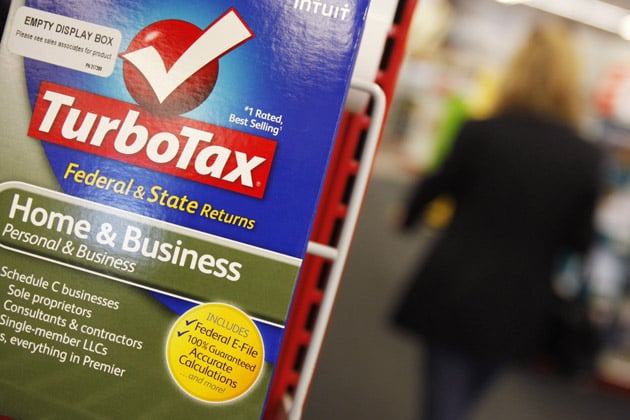
Intuit, producer of the top-selling tax software TurboTax, has opposed letting the government do your taxes for free – even though it could save time and headaches for millions of filers. (Shannon Stapleton/Reuters)

by Liz Day
ProPublica, March 26, 2013, 5 a.m.

Imagine filing your income taxes in five minutes — and for free. You'd open up a pre-filled return, see what the government thinks you owe, make any needed changes and be done. The miserable annual IRS shuffle, gone.

It's already a reality in Denmark, Sweden and Spain. The government-prepared return would estimate your taxes using information your employer and bank already send it. Advocates say tens of millions of taxpayers could use such a system each year, saving them a collective $2 billion and 225 million hours in prep costs and time, according to one estimate.

The idea, known as "return-free filing," would be a voluntary alternative to hiring a tax preparer or using commercial tax software. The concept has been around for decades and has been endorsed by both President Ronald Reagan and a campaigning PresidentObama.

"This is not some pie-in-the-sky that's never been done before," said William Gale, co-director of the Urban-Brookings Tax Policy Center. "It's doable, feasible, implementable, and at a relatively low cost."

So why hasn't it become a reality?

Well, for one thing, it doesn't help that it's been opposed for years by the company behind the most popular consumer tax software — Intuit, maker of TurboTax. Conservative tax activist Grover Norquist and an influential computer industry group also have fought return-free filing.

Intuit has spent about $11.5 million on federal lobbying in the past five years — more than Apple or Amazon. Although the lobbying spans a range of issues, Intuit's disclosurespointedly note that the company "opposes IRS government tax preparation."

The disclosures show that Intuit as recently as 2011 lobbied on two bills, both of which died, that would have allowed many taxpayers to file pre-filled returns for free. The company also lobbied on bills in 2007 and 2011 that would have barred the Treasury Department, which includes the IRS, from initiating return-free filing.

Intuit argues that allowing the IRS to act as a tax preparer could result in taxpayers paying more money. It is also a member of the Computer & Communications Industry Association (CCIA), which sponsors a "STOP IRS TAKEOVER" campaign and a websitecalling return-free filing a "massive expansion of the U.S. government through a big government program."

In an emailed statement, Intuit spokeswoman Julie Miller said, "Like many other companies, Intuit actively participates in the political process." Return-free programs curtail citizen participation in the tax process, she said, and also have "implications for accuracy and fairness in taxation." (Here is Intuit's full statement.)

In its latest annual report filed with the Securities and Exchange Commission, however, Intuit also says that free government tax preparation presents a risk to its business.

Roughly 25 million Americans used TurboTax last year, and a recent GAO analysis said the software accounted for more than half of individual returns filed electronically. TurboTax products and services made up 35 percent of Intuit's $4.2 billion in total revenues last year. Versions of TurboTax for individuals and small businesses range inprice from free to $150.

(H&R Block, whose tax filing product H&R Block At Home competes with TurboTax, declined to discuss return-free filing with ProPublica. The company's disclosure forms state that it also has lobbied on at least one bill related to return-free filing.)

* * *

Proponents of return-free filing say Intuit and other critics are exaggerating the risks of government involvement. No one would be forced to accept the IRS accounting of their taxes, they say, so there's little to fear.

"It's voluntary," Austan Goolsbee, who served as the chief economist for the President's Economic Recovery Advisory Board, told ProPublica. "If you don't trust the government, you don't have to do it."

Goolsbee has written in favor of the idea and published the estimate of $2 billion in saved preparation costs in a 2006 paper that also said return-free "could significantly reduce the time lag in resolving disputes and accelerate the time to receive a refund."

Other advocates point out that the IRS would be doing essentially the same work it does now. The agency would simply share its tax calculation before a taxpayer files rather than afterward when it checks a return.

"When you make an appointment for a car to get serviced, the service history is all there. Since the IRS already has all that info anyway, it's not a big challenge to put it in a format where we could see it," said Paul Caron, a tax professor at University of Cincinnati College of Law. "For a big slice of the population, that's 100 percent of what's on their tax return."

Taxpayers would have three options when they receive a pre-filled return: accept it as is; make adjustments, say to filing status or income; or reject it and file a return by other means.

"I've been shocked as a tax person and citizen that this hasn't happened by now," Caron said.

Some conservative activists have sided with Intuit.

In 2005, Norquist testified before the President's Advisory Panel on Federal Tax Reform arguing against return-free filing. The next year, Norquist and others wrote in a letter to President Bush that getting an official-looking "bill" from the IRS could be "extremely intimidating, particularly for seniors, low-income and non-English speaking citizens."

Norquist, founder of Americans for Tax Reform, declined to comment, but a spokesman pointed to a letter he and other conservatives sent this month to members of Congress. The letter says the IRS wants to "socialize all tax preparation in America" to get higher tax revenues.

A year after Norquist wrote Bush, a bill to limit return-free filing was introduced by a pair of unlikely allies: Reps. Eric Cantor, R-Va., the conservative House majority leader, and Zoe Lofgren, D-Calif., a liberal stalwart whose district includes Silicon Valley.

Intuit's political committee and employees have contributed to both. Cantor and his leadership PAC have received $26,100 in the past five years from the company's PAC and employees. In the last two years, the Intuit PAC and employees donated $26,000 to Lofgren.

A spokeswoman said in an email that Cantor "doesn't believe the IRS should be in the business of filling out your tax returns for you," and that the bill was designed to "prevent the IRS from circumventing Congress."

Lofgren did not respond to requests for comment.

* * *

Intuit did not issue public statements on the return-free filing bills, but CCIA President Ed Black has called return-free filing "brilliantly Machiavellian." When Sens. Ron Wyden, D-Ore., and Dan Coats, R-Ind., introduced a bipartisan tax reform bill in 2011 that included a return-free plan called "Easyfile," Norquist blasted it.

"The clear goal of this measure is to raise taxes in a way that leaves politicians with clean hands," he wrote in a letter to the two senators.

Political opposition hasn't been the only hurdle. Supporters say return-free filing has been overshadowed in a tax debate that has focused more on rates, deductions and deficits.

Further, return-free filing would not be available to everyone. It's best for the slice of taxpayers with straightforward returns who don't itemize or claim various credits.

Still, past studies estimate that this group might include 40 percent of filers or more; the IRS expects to process 147 million individual returns this year.

In separate reports, the CCIA and a think tank that Intuit helps sponsor argue that potential costs outweigh return-free filing's benefits. Among other things, the reports say that not many taxpayers are likely to use return-free, that new data reporting requirements could raise costs for employers, and that taxpayers could face new privacy and security risks.

The reports and Intuit also note that many taxpayers can already get free tax filing through the Free File Alliance, a consortium involving the IRS and a handful of companies. But last tax year, only about 3 million filers had used Free File, according to a Treasury tally through April 28.

In an SEC filing, Intuit said it provided about 1.2 million free federal returns for the 2011 tax season. The company and competitors typically advertise free federal filing on the Web but also pitch other paid services, such as filing certain state returns.

Government studies have split about whether a return-free system would save or cost the IRS money, according to a 2003 Treasury report. Unless the tax code was simplified, the report said, it would add work for employers and the IRS, which would have to process tax records sooner.

Some independent tax experts see potential problems with a return-free system.

Eric Toder, co-director of the Urban-Brookings Tax Policy Center, said the IRS, "an overpressed agency that's being asked to do a lot of things," shouldn't be asked to do what software companies could easily do.

James Maule, a professor at Villanova University School of Law, said the average taxpayer probably wouldn't scrutinize a pre-filled return for accuracy or potential credits. "Some people might get this thing that says this is your tax bill and just pay it, like with property tax bills," said Maule.

* * *

So far, the only true test case for return-free filing in the U.S. has been in Intuit's home state.

In 2005, California launched a pilot program called ReadyReturn. As it fought against the program over the next five years, Intuit spent more than $3 million on overall lobbying and political campaigns in the state, according to Dennis J. Ventry Jr., a professor at UC Davis School of Law who specializes in tax policy and legal ethics.

Explaining the company's stance, Intuit spokeswoman Miller told the Los Angeles Timesin 2006 that it was "a fundamental conflict of interest for the state's tax collector and enforcer to also become people's tax preparer."

The following month, an ad in The Sacramento Bee, paid for by the CCIA, cautioned "Taxpayers beware" and said ReadyReturn "could be very harmful to taxpayers." The ad pointed to a now-defunct website, taxthreat.com, opposing ReadyReturn.

Former California Republican legislator Tom Campbell recalls being surprised at the opposition.

"The government imposed the income tax burden in the first place," he told ProPublica. "So if it wants to make it easier, for heaven's sake, why not?"

In a Los Angeles Times op-ed at the time, Campbell wrote he "never saw as clear a case of lobbying power putting private interests first over public benefit."

Joseph Bankman, a Stanford Law School professor who helped design ReadyReturn, says he spent close to $30,000 of his own money to hire a lobbyist to defend the program in the legislature. Intuit made political contributions to scores of legislative candidates, Bankman said, and gave $1 million in 2006 to a group backing a ReadyReturn opponent for state controller.

ReadyReturn survived, but with essentially no marketing budget it is not widely known. Fewer than 90,000 California taxpayers used it last year – although those who do use it seem to be happy. Ninety-eight percent of users who filled out a survey said they would use it again. The state's tax agency has also praised ReadyReturns, saying they are cheaper to process than paper returns.

Bankman thinks national return-free filing could make many others happy, too. "We'd have tens of millions of taxpayers," he said, "no longer find April 15 a day of frustration and anxiety."

Want to keep up with stories like this? Follow ProPublica on Facebook and Twitter.