DANCING NEBULA

DANCING NEBULA
When the gods dance...
Showing posts with label Politics. Show all posts

Thursday, April 18, 2013

Clinton, Bush and Obama: US War Crimes over Three Administrations


By Ed Hightower

Global Research, April 17, 2013

torture

On Tuesday, the Constitution Project, a Washington, DC think tank, released a 600-page report by its “Task Force on Detainee Treatment” documenting decades of war crimes committed by US imperialism and its military and intelligence agencies.

The 11-member Task Force spent two years generating the report, interviewing over 100 individuals, including former detainees, military and intelligence operatives, interrogators and politicians in numerous countries. The report details abuse of detainees during the Clinton, Bush and Obama administrations, and geographically covers such mistreatment in Iraq, Afghanistan, Guantanamo Bay and the so-called black sites where the US government hides detainees in secret locations in foreign countries.

The report relies on publicly available documents, since the Task Force had no access to records kept by the military on the treatment of detainees. Nor could it compel testimony from witnesses or participants, since it lacked the power to issue subpoenas.

Nonetheless, the Task Force amassed an enormous and overwhelming quantity of evidence on US crimes. The report’s introduction contains this indictment of the American government’s conduct in the so-called “war on terror”:

“The events examined in this report are unprecedented in US history. In the course of the nation’s many previous conflicts, there is little doubt that some US personnel committed brutal acts against captives, as have armies and governments throughout history. But there is no evidence there had ever before been the kind of considered and detailed discussions that occurred after September 11, directly involving a president and his top advisors on the wisdom, propriety and legality of inflicting pain on some detainees in our custody.”

The introductory remarks go on to note: “Despite this extraordinary aspect, the Obama administration declined, as a matter of policy, to undertake or commission an official study of what happened, saying it was ‘unproductive’ to ‘look backwards’ rather than forward.”

The report offers a glimpse into the manner in which the judiciary has adapted itself to and facilitated the ever-expanding powers of the executive branch of government. Characterizing the role of the federal courts during the post-9/11 Bush administration, the report makes the following point:

“Courts, ever anxious about the possibility of defiance undermining their authority, generally allowed the administration to delay action.” In other words, according to the Task Force, the courts have largely gone along with the anti-democratic measures enacted in the name of the “war on terror” out of fear that the executive branch might simply ignore their rulings, effectively establishing an open presidential dictatorship.

A comprehensive account of the details of the report goes beyond the scope of a single article, and the World Socialist Web Site intends to devote additional articles to the material laid out in this important study. But by way of introduction, the section headings provide a sense of the report’s scope. They include: “Detention at Guantánamo,” “The Legal Process of The Federal Government After September 11,” “Rendition and the ‘Black Sites,’” “The Role of Medical Professionals in Detention and Interrogation Operations,” “True and False Confessions: The Efficacy of Torture and Brutal Interrogations.”

The report declares that the US government “indisputably” engaged in torture, which was approved by “the nation’s highest officials.” Specifically, the Task Force rejects the notion that stress positions, sleep deprivation, exposure to continuous loud music, water boarding and other “enhanced interrogation tactics” do not amount of torture under US and international law.

As of late 2012, the Task Force writes, the US military was still capturing around 100 persons every month for detention at the notorious Baghram Air Base prison in Afghanistan, many of them grabbed in night raids.

The report notes that “extraordinary renditions” became a regular practice during the Clinton administration in the late 1990s. Richard Clarke, the chief counter-terrorism adviser to Clinton, is quoted as saying Clinton approved every single “snatch” operation he was asked to review.

The Task Force declares that US personnel committed acts of torture and other cruel, degrading or inhumane acts at the CIA’s “black sites” against the victims of extraordinary rendition.

Following the 9/11 attacks, the report points out, military psychologists were told they had no obligation to follow any medical ethical standards aside from those handed down by the military itself.

The report notes that one of the first detainees in the “war on terror,” the supposed “20th hijacker” in the 9/11 attacks, Mohammed Al Qahtani, was interrogated for 20 hours per day for seven weeks. He was interrogated in stress positions with military working dogs present and held in solitary confinement. He was also questioned naked in front of female interrogators, led around on a leash and made to bark like a dog, over-injected with IV fluids in order to make him urinate on himself, and forced to wear women’s underwear.

An Army pathologist’s report on the in-custody death of a detainee known only as Daliwar at Bagram Air Base found that the prisoner’s legs were beaten so savagely that they became “pulpified,” and that his injuries resembled those of someone who had been run over by a truck. Daliwar, a 22-year-old taxi driver, was innocent of any crime.

A picture emerges of the preparations for a police state, from the more embryonic stage under Bill Clinton to the more open and developed stage under George W. Bush and Barack Obama.

The Constitution Project’s report documents the regular use of torture at the Guantanamo Bay internment camp, which has become a symbol of the brutality of American imperialism. Some 166 men have been detained there for years, most without having been accused of a crime, and all without a trial or basic due process of law. Many have tried to commit suicide. Six have succeeded.

The release of the new study coincided with a crackdown by US military guards at Guantanamo against a month-long hunger strike by as many as 100 detainees.

On Monday, the New York Times published a letter from current inmate Samir Naji al Hasan Moqbel, which sheds light on the savage treatment that he and his peers endure.

“I will never forget,” the inmate states, “the first time they passed the feeding tube up my nose. I can’t describe how painful it is to be force-fed this way. As it was thrust in, it made me feel like throwing up. I wanted to vomit, but I couldn’t. There was agony in my chest, throat and stomach. I had never experienced such pain before. I would not wish this cruel punishment upon anyone.”

The Task Force report points to the international legal condemnation of force-feeding detainees and recommends that the practice cease immediately.

The Constitution Project’s report on detainee treatment is as an encyclopedia of criminality, although the study’s liberal authors refrain from drawing substantive conclusions and offer only the most feeble recommendations.

But while they do not propose that anyone be prosecuted, their findings provide powerful evidence for war crimes proceedings against three US presidents and their subordinates, including cabinet members, Department of Justice lawyers, military commanders and intelligence officials.

Thursday, April 11, 2013

Obama budget throws American people under the bus, gives the rich a free ride

Jill Stein, the Green Party's 2012 presidential candidate today condemned the recently released Obama 2014 budget proposal, issuing the following statement:

"Despite his campaign promises to protect Social Security and make the economy fair, Obama’s budget throws the American people under the bus. And it gives the economic elite a free ride on that same bus that’s running us over.

Specifically, this budget swaps the painful $1.2 trillion in sequester cuts for a different, but equally painful, new package of cuts worth the same amount. As part of these new cuts, the President is leading the charge to roll back Medicare and Social Security – the “Grand Bargain” with ruthless corporate Republicans that Obama has promoted for years. There is nothing grand about dismantling the crown jewels of the New Deal and the Great Society.
Under the bus

The new cuts are superimposed on $1.4 trillion in cuts since 2011 that are already hurting our jobs, schools, health care, housing and social support systems. The burden this budget imposes on the wealthy is trivial by comparison – such as ending tax-benefits in private retirement accounts for those fortunate few with over 3 million already salted away.


The President’s budget proposes $400 billion in Medicare and other health care cuts, partly through requiring seniors to increase Medicare payments or reduce their coverage. Obama also calls for “means testing” Medicare, making it a benefit only for middle class and low income seniors rather than for everyone over age 65. This is a time-tested strategy to reduce public support and set a program on the road to virtual extinction – as was done to welfare under Clinton.

Obama’s budget would reduce Social Security benefits by switching to a “chained CPI” method for calculating cost of living increases. The average retiree would lose more than 2% of her income in the deal. This is more than three times the burden imposed by Obama’s nominal tax increase on the rich last year, which would amount to a mere 1/2 % of income for a wealthy couple earning half a million dollars a year.

Obama is targeting Social Security despite the fact that it's the only thing keeping 20 million seniors out of poverty. Its payments relative to pre-retirement income are far below the retirement benefits that most European nations provide. Few Americans support Obama's approach. According to a February 2013 Pew poll, only 10% of Americans want to cut Social Security while 41% want to increase Social Security benefits.

Obama’s budget will make a desperate economic situation even worse. Last month’s job figures showed only 88,000 new jobs were created, about half the number needed to keep real unemployment from rising. It also showed nearly a half million people had dropped out of the workforce, which largely explains the illusory, small decline in "official" unemployment. In fact the more accurate unemployment indicator, the employment to population ratio, (EPOP), shows a pathetic recovery of only about 7% of the jobs lost since 2007. Meanwhile 1 in 2 Americans are in poverty or low income, 37 million college students and recent graduates are in debt with few prospects for getting out. And with 90% of projected new jobs not requiring a college degree, and half not even requiring a high school degree - the ranks of the impoverished are, unfortunately, on a steep curve upward.
For the President – and his Republican and Democratic accomplices in Congress – to impose these austerity cuts on the American people is absolutely unjustified. Considering the economic meltdown that so many Americans are facing, it is unconscionable. The core problem of the American economy is not the budget deficit. This is simply a symptom of the bigger disease: the recession (caused by Wall Street malfeasance) which led to the massive 2008 drop in tax revenues. The deficit was further aggravated by Wall Street bailouts, the Bush/Obama tax giveaways for the rich, private medical insurance inflation, and the disastrous $6-trillion dollar military boondoggles in Iraq and Afghanistan.


The real solution to the recession is to jump start the economy through a massive job creation program – like the New Deal that sparked the recovery from the Great Depression. Within the first few months of the FDR’s New Deal, millions of jobs were created, and within a few years, over 12 million people were back to work.
An alternative to the grim Grand Bargain is offered by the Green New Deal, a package of emergency reforms proposed by the Green Party. This approach would end both the economic crisis and the climate crisis in one fell swoop. It would create 25 million jobs in green energy, sustainable agriculture, public transportation and infrastructure improvements – as well as jobs that meet our social needs, including teachers, nurses, day care, affordable housing, drug abuse and violence prevention and rehabilitation. It would be funded by scaling back the oversized military budget to year 2000 levels, adopting a Medicare for All insurance system that would save trillions of dollars, requiring Wall Street gamblers to pay a small (0.5%) sales tax, taxing capitol gains as income, and taxing income more progressively. These key provisions of the Green New Deal enjoy majority public support in poll after poll.


The Green New Deal addresses the concocted deficit/debt problems by solving the bigger, underlying crises of an unraveling economy and accelerating climate catastrophe. The enormity of these threats compel solutions of equal magnitude.


The draconian budget being presented by the Obama White House is a sobering sign that that the corporate-sponsored political establishment is incapable of delivering real solutions to the nation's critical problems.

With growing frequency, unions and advocacy groups are expressing buyer's remorse about this President, and sending out fundraising appeals asking for money so that they can "take him on." It’s worth asking when "taking him on" should become "leaving him behind," and organizing for independent political action.
One thing is clear – the clock is ticking on our imperiled economy and climate. More than ever, it’s time to put our voices, our bodies, and our votes behind real solutions for a peaceful, just, green future for us all."
TO LEARN MORE ABOUT THE GREEN NEW DEAL:
http://www.jillstein.org/green_new_deal


Please take an immediate step by making a donation: http://www.jillstein.org/donate

Authorized and paid for by Jill Stein for President
PO Box 260217, Madison, WI 53726
http://www.jillstein.org

Saturday, April 6, 2013

How conservatives still run America, despite losing elections

FRIDAY, APR 5, 2013 12:30 PM PDT


From guns to Social Security to FISA, the real majority party prevails while liberals lose out again


BY AMITAI ETZIONI

How conservatives still run America, despite losing elections

There is more than may appear in President Obama’s plan to cut the social safety net in his new budget proposal. The offer, on the face of it, reflects a significant violation of a major liberal creed, discarding the strongest liberal political card and Obama’s peculiar negotiation style of making major concessions at the opening of a give-and-take session. But it also reflects the sad but true fact that the dynamics of American politics cannot be understood in terms of Democrats vs. Republicans. Party labels aside, the nation is still being ruled by what I call a majority “conservative party.”

If Democrats and Republicans were the true divide, the meager gun control measures recently introduced in the Senate would have the majority needed to pass. After all, there are 53 Democratic Senators (and two Independents who generally side with them). Moreover, this time, the threat of a GOP filibuster is not to blame. Yet the Democratic majority leader, Senator Harry Reid, removed the assault weapons ban from the draft bill because some 15 Democratic senators, in effect, supported the conservative pro-gun position, making up — with the Republican senators — that majority “conservative party.” Thanks to this party, the same legislative defeat is about to befall liberal proposals to curtail high-capacity magazines. This leaves only better background checks on the table, but these, too, will inevitably be rendered ineffective by the conservatives via the underhanded gutting of enforcement (more about this shortly).

Social security and gun safety are but a couple of the numerous issues on which conservatives in Washington get their way and the minority liberal party loses out. Most recently, every Republican and 33 Democratic conservatives came together to repeal a tax on medical devices, a major source of funding for Obamacare. And on Dec 28, the conservative party — 42 Republicans, 30 Democrats and 1 Independent senator — voted to extend the foreign intelligence law known as FISA, opposed by civil libertarians. We should further expect that the conservative party will keep winning on many fronts, from greatly limiting all new investments in education to unduly slashing social spending.

Some argue that the president is trying to build up a broad following so that, come the 2014 elections, the Democrats will carry the House and he will be able to push through a progressive agenda in the second half of his term. These doe-eyed optimists disregard the fact that, even if the Democrats hold both chambers, the additional Democrats elected in 2014 will largely be from so-called red (i.e., conservative) districts. The situation then will be much like it was in 2009 when the Democrats had a majority in the House, a filibuster-proof majority in the Senate and a president in the White House and yet still could enact very little progressive legislation. The reason? Very much the same: conservative Democrats voting with the GOP to extend the Bush tax cuts, cut social spending, weaken financial regulations and so on.

I must regretfully add that the situation in Washington is even bleaker than what I have laid out so far. While gun control legislation makes its way through Congress (we may get slightly stricter background checks), the conservatives in Congress have passed various measures that eviscerate the agency charged with enforcing these background checks, new and old, thereby ensuring that they will remain weak and ineffective. Liberals tend to focus on passing laws; conservatives, when they cannot block or weaken the laws themselves, see to it that they are not enforced.

Conservatives in Congress have a long history of undermining the Bureau of Alcohol, Tobacco, Firearms and Explosives (ATF), and new moves to this effect pile on top of old ones. The Firearms Owners’ Protection Act of 1986 bans the ATF from inspecting gun dealers more than once in any 12-month period, even if violations are uncovered, and it reduces record-keeping violations from a felony to a misdemeanor offense, the result being that they are very rarely prosecuted. The 2003 and 2004 Tiahrt amendments, named for their sponsor Rep. Todd Tiahrt, require that records from the background checks of gun buyers be destroyed within 24 hours, bar requiring gun dealers to conduct inventory checks to monitor gun thefts, and prevent crime gun trace data from being used in court, even when a dealer has broken the law. In addition, Congress has barred the ATF repeatedly from creating a computerized database, so when a gun is recovered at a crime scene, agents must manually search through boxes of paper records to trace the firearm to dealer or purchaser.

Most recently, with the prospect of new gun-safety legislation on the horizon, the House and Senate appropriations committees — including both Republicans and Democrats — have tacked “riders” onto a short-term spending agreement that make permanent what had previously been a set of temporary, pro-gun provisions. The bill prohibits the Justice Department from keeping an inventory of gun dealers. It also prevents the ATF from refusing to renew the licenses of dealers “due to a lack of business activity,” thereby hampering law enforcement’s ability to clamp down on illegitimate dealers, and includes a requirement that the ATF disclose in its reports that gun trace data “cannot be used to draw broad conclusions about firearms-related crime.” The details of these amendments are “boring” — they rarely make headlines. However, they do tie the hands of the ATF and send a message to the dealers: We have your back. And the ATF agents would be foolish to ignore the implied warning: Take it easy or expect new obstacles. Case in point: In January 2013, President Obama sought to reinvigorate the agency by giving it a director (something it has not had in six years), but his nominee, B. Todd Jones, has yet to be confirmed because of conservative opposition. This further hamstrings the ATF, as there are many operations that agencies without a director are banned from undertaking.

A favorite line of the National Rifle Association is, “Why not just enforce the laws that are already on the books?” A very good question, and the answer is exceedingly clear: Because the conservative party won’t let us. Further, we will not progress in curbing gun violence — or on most other political fronts — until we correctly read the political layout.

We have a conservative majority and a liberal minority, not two more or less equal parties. How we may change this line-up is the political challenge of the generation. But one thing is for sure: Simply voting for Democrats will not do the trick.

Amitai Etzioni is the University Professor at The George Washington University, and author of From Empire to Community.MORE AMITAI ETZIONI.

Obama making historic mistake on Social Security

FRIDAY, APR 5, 2013 05:15 AM PDT


The President's proposal to cut the social safety net may someday look as retrograde as Clinton signing DOMA


BY MICHAEL LIND

Obama making historic mistake on Social Security

President Obama reportedly is unveiling a budget using the chained CPI inflation measure to cheat elderly Americans out of the benefits they were promised. In two previous posts I’ve explained the perversity of the current debate about Social Security. The tax-favored private components of America’s mixed private-public retirement system — programs like employer pensions, 401Ks and IRAs — are inefficient, volatile and subject to manipulation by overcompensated, fee-extracting money managers. In contrast, the Social Security program is simple and efficient, and has low overhead costs. And yet the bipartisan establishment, including many “progressive” Democrats as well as Republicans, wants to cut Social Security — the part that works — and expand tax-favored private savings, the inefficient, unstable and inequitable part.

While cutting Social Security makes no sense at all in terms of economics or public policy, it makes excellent sense in terms of the selfish class interests of the super-rich.  They have extracted about half the gains from economic growth in the U.S. in the last half-century and recycle some of their profits to fund politicians, and lobbyists, as well as mercenary propagandists who pose as neutral think tank experts. Social Security’s contribution to the retirement income of the rich is negligible, while the top 20 percent receives around 80 percent of the income from tax-favored private retirement savings accounts like 401Ks. Naturally many of America’s oligarchs want the public discussion to be solely about cutting Social Security benefits for the bottom 80 percent, rather than 401Ks for the top 20 percent. To paraphrase Leona Helmsley, Social Security is for the little people. And if we cannot afford all of our present public-plus-private retirement system … well, as the saying in Tsarist Russia had it, let any shortage be shared among the peasants.

Elite discourse on this subject is radically at odds with public opinion. According to a February 2013 Pew poll, only 10 percent of Americans want to cut Social Security while 41 percent want to increase Social Security benefits. It’s time to change the public conversation about retirement security in America to reflect the beliefs and interests of the struggling many, not the fortunate few. We need to change the subject from cutting Social Security while subsidizing luxury retirements for the elite to cutting retirement subsidies for upper-income groups while expanding Social Security benefits for the majority of American retirees.

The simplest way to expand Social Security would be simply to expand the present Social Security program: Old Age and Survivors Insurance (OASI). But OASI is paid for solely by the payroll tax, a regressive tax that falls most heavily on lower-income workers.  Today individuals pay the payroll tax only on wages up to$113,700. Raising the payroll tax cap could contribute to reducing the shortfall between payroll tax revenues and promised Social Security benefits that is expected to open up in the 2030s. Lifting the cap entirely might eliminate the shortfall entirely.

But even if the present system’s future funding needs are met, Social Security as it now exists is inadequate to compensate for the rapid disappearance of traditional pensions and the failure of 401Ks, IRA(s) and other tax-expenditure-subsidized private retirement savings. And Social Security is not very generous, by international standards. In the Natixis Global Retirement Index, the U.S. ranks 19th — behind countries like Slovakia and the Czech Republic. The gross replacement rate for the average earner (how much pre-retirement income is replaced by public or publicly mandated benefits) is only around 40 percent, while the average in the European Union is more than 60 percent.

In response to the failure of the private retirement system, we should go beyond merely maintaining the public share of retirement income to expanding it. In a new paper, “Expanded Social Security: A Plan to Increase Retirement Security for All Americans,” Steven Hill, Robert Hiltonsmith, Joshua Freedman and I propose boosting public benefits from 40 percent to 60 percent of pre-retirement income for the medium earner, making reliance on failed and inequitable private savings programs less necessary. We would do so by fully funding the existing OASI program, which would be renamed Social Security A, and adding an additional universal, flat benefit called Social Security B.

As a thought experiment, we calculated how big Social Security B would have to be in 2035, if Social Security A and B combined were to add up to 60 percent of pre-retirement income for the average earner instead of today’s 40 percent for today’s Social Security alone (the thought experiment is not wholly realistic, as it leaves out transitions from the present system and other complications). Strikingly, the inflation-adjusted number that resulted from this back-of-the-napkin thought experiment, $11,699 a year, is very close to what a poverty-level, universal basic income for the elderly would be; in 2013 the official poverty level for a single individual is $11,490.

Because Social Security B, like Social Security A, would be universal, all economic classes would benefit, although in diminishing degrees as their other sources of retirement income rose. While the biggest winners would be low earners, who would enjoy nearly 100 percent pre-retirement replacement rates from public funding in the new system, high earners would benefit somewhat as well.

To pay for the two components of Expanded Social Security — fully funded Social Security A and the new flat benefit, Social Security B — we would have to raise an additional 5 percent of GDP a year in taxation. While that sounds like a lot, the only relevant number is the percent of GDP that would be disbursed to retirees by all government-sponsored programs — a category in which we include defined benefit pensions, 401Ks and IRAs as well as today’s Social Security program. Under our scenario, in 2035 a slightly lower portion of the economy would be devoted to government-backed public and private retirement plans than would be the case if our present system continues unchanged.The funding of Expanded Social Security would also be far more progressive than today’s system.

The present OASI program, although it is funded by a regressive payroll tax, is moderately redistributive in its benefits formula. The additional Social Security B benefit we propose would be a universal basic income for the elderly paid for by taxes other than payroll taxes, such as general revenues, or a dedicated tax, such as a portion of a new federal value-added tax. Either general revenues or a VAT from which necessities were exempted would be far more progressive than the payroll tax, increasing the progressivity of the new two-tier Social Security system on the revenue side. While our plan devotes no more money to spending on retirement, as a share of the overall American economy, than does the present system, the well-off minority of American would take a big hit, notwithstanding the small benefit they derive from Social Security B.If the present system continues, then tax-sheltered private savings plans will pay out more in retirement income in 2035 (7.5 percent) than unreformed Social Security (5.6 percent). Most of that 7.5 percent will go to the affluent and the rich.

What possible public interest can there be in having all American taxpayers subsidize the retirement savings of the rich? If any tax-favored private savings plans are to exist at all, there should be strict contribution limits — say, $5,000 per year — to prevent the rich from squirreling away money and benefiting from compound interest at the taxpayer’s expense. The wealthy supporters of Social Security cuts say Americans should compensate by saving more. Well, let the rich set an example by saving more if they want to, once we take away most of their retirement savings tax breaks.

Needless to say, in today’s money-soaked Washington the chances that our Expanded Social Security plan will be enacted are slim to none. Our purpose in putting forth this plan is to change the debate by moving the goal posts. Today the “progressive” position is merely paying for promised benefits; the “conservative” position is abolishing Social Security completely; and the “moderate” or “centrist” position is cutting Social Security.

In the new debate — foreshadowed not only by our plan, but by influential thinkers like Josh Barro, Matthew Yglesias and Duncan Black, who might not endorse our particular proposal — the new “progressive” position, as it were, would be dramatically expanding Social Security; paying all promised benefits would be the new “center”; and cutting Social Security, by means of a higher retirement age, means-testing, or using inflation to rob seniors of promised benefits (“chained CPI), would be the right-most position. President Obama, in reportedly proposing to cut benefits for the elderly with chained CPI, should be careful, or he will end up looking as right-wing in retrospect as President Clinton does now for signing rather than vetoing the Defense of Marriage Act.

Until now, the debate about the future of Social Security has been rigged by the rich and right wing and their minions. It’s time for a genuine debate to begin.

This is the third in a three-part series. Read parts I and II.

Michael Lind is the author of Land of Promise: An Economic History of the United States and co-founder of the New America Foundation.MORE MICHAEL LIND.

Inspiration is Contagious!

Because a sustainable future depends on the people willing to see the truth for what it is, and for those to stand up in unison in order to make a difference.

— Jake Edward Keli'i Eakin

Stop the Machine! Create a new World! October2011.org

October 2011

Inspiration is Contagious: Native Indians, Workers, Climate, Food and Torture Activists, and a Polar Bear

A group of Native American women are walking the length of the Mississippi river - 1,200 miles - to raise awareness about pollution. They carry a 1½ quart  bucket of clean water from the headwaters of the Mississippi which they plan to pour into the mouth of the river to show the her what she can be.

Climate Justice activists may be more powerful than we realize. The French energy company, Total, sold its 49% ownership in the Canadian oil sands to the Canadian energy company, Suncor, for a $1.65 billion loss. Why? The cost is getting too expensive and profits are going down. With all of the highly publicized tar sands spills recently in Minnesota, Arkansas and other states, people are seeing the environmental risks.  Since we know that the Alberta Tar Sands is the tipping point for climate change, shouldn’t corporations be held accountable for the climate disasters that will inevitably follow? Protest pressure is building. See here and here.
The hunger strike continues. Solidarity protests were organized last week by Witness Against Torture against the Guantanamo Bay prison. Guantanamo is an example of criminal injustice. The trial against the NYPD’s Stop and Frisk program is exposing the practice of racial targeting by New York police. This week, one of the commanders caught on tape settled a lawsuit against him for $78,000.  We wrote an overview of the abusive criminal (in)justice system, “A Forest of Poisonous Trees.”

In New York City, low-wage, fast food workers walked off the job today in the largest-ever strike against the fast food industry which has virtually no unions. Workers are demanding that chains like McDonald’s and Wendy’s raise their wages to $15 an hour and allow them to organize a union without retaliation. More than 400 workers, from 50-some stores, will participate in the surprise strike, doubling the size of their previous walkout and potentially shutting down several fast food restaurants for the day. Waging Nonviolence published an article that explained what it takes to organize a workplace.
With the passage of the Monsanto Protection Act, which protects Monsanto’s dangerous GMO foods from litigation, more people are speaking out. The nation’s food supply, already in bad shape, will be put at greater risk as Congress gets more deeply in bed with the massive corporate criminal, Monsanto.
Seven thousand coal miners and their families protested in West Virginia against Peabody Coal which set up a sham corporation designed to go bankrupt and take the pensions and health care of workers with them by terminating the contract between the United Mine Workers Union negotiated with Peabody.
Teachers are organizing to take back education from the corporations as part of the commodification of American youth. This weekend Occupy the Department of Education is holding a series of teach-ins in Washington, DC.
We’re reminded how important the corporate take-over of our culture is by an Occupy Barbie protest against a life-sized Barbie house that is opening in Berlin and planning a European tour. Haven’t we grown beyond Barbie as the symbol for women?
It’s not only corporations that pollute culture, white supremacists continue to do their dirty work. The KKK went to the black majority city of Memphis to protest the city changing the name of a park from a past Grand Dragon of their despicable organization. Thousands turned out to protest the KKK – as usual in these cases, more protesters than KKKers. Students, faculty and the university president at Towson University celebrated diversity in protest of a new unofficial white supremacist group, the White Student Union.
This week we were reminded that we are part of a global movement, when 50,000 went to Tunisia for the World Social Forum; Medea Benjamin gives us a report.  A thousand people marched to where the fruit vendor set himself on fire in December 2010 and sparked not only a revolt in Tunisia but the Arab Spring and the Indignado and Occupy movements. They held a mass General Assembly at the spot. The World Social Forum issued a declaration which made many important points and described the work of all of us:
"​Together, the peoples of all the continents are fighting to oppose the domination of capital, hidden behind illusory promises of economic progress and the illusion of political stability."
We love this photograph of a one-person protest against artic drilling on the Moscow River near the Kremlin.  It shows that you don’t need a lot of people to effectively get out your message.  Will we see this on the Potomac?
A few more people can do even more. These 8 families in Minnesota declared an eviction-free zone stating “We will no longer be held hostage by the financial institutions that crashed our economy. We hereby declare our community a Foreclosure and Eviction Free Zone. We will not leave our homes until the following demands are met.”  They go on to list specific demands and conclude saying “We believe that safe, equitable, and affordable housing is a human right. We shall not be moved.”
There are issues that unite all of us; perhaps the most important is the global corporate coup – the Trans-Pacific Partnership.  It is becoming more and more evident that no matter what issue you care about – financial regulation, food, healthcare, climate change, jobs and wages, the environment . . . – the TPP will undermine your work. The TPP should bring us together. And, it is a fight we can win.  The time to get active is now. There is strength in solidarity.
Finally, we were reminded how the Occupy movement scared the power structure is of the people as more information was released about government efforts to suppress the movement, resulting in a variety of news reports.
In peace and solidarity,
Kevin, Margaret and October2011/OccupyWashingtonDC
PS: To share this email on Facebook, Twitter, etc, click here for a link.

Copyright © 2011 October 2011, All rights reserved.
Our mailing address is:

October 2011

PO Box 102011

Washington, DC 20001

Wednesday, April 3, 2013

A MuckReads Guide to North Korea


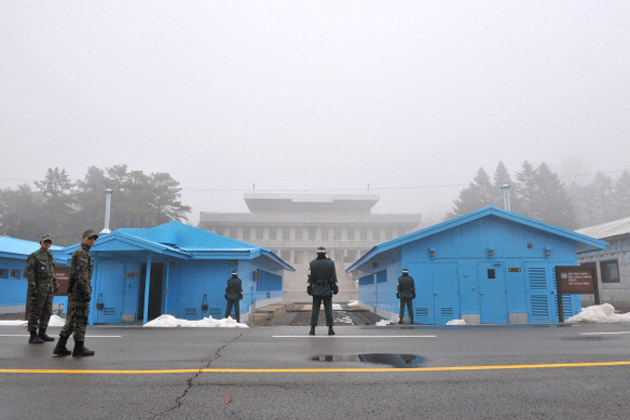
South Korean soldiers stand guard at the truce village of Panmunjom in the demilitarized zone dividing North and South Korea, Feb. 27, 2013. (JUNG YEON-JE/AFP/Getty Images)

ProPublica, April 2, 2013, 2:31 p.m.

  • As tensions simmer over North Korea’s latest nuclear threats, we take a look at some of the best reading on Kim Jong Un, the prospects for a nuclear conflict and life in the DPRK. What did we miss? Tweet your recommended reading with #MuckReadsor leave us a note in the comments below.

Meet Kim Jong Un, Time, February 2012
When Kim Jong Il died in December 2011, there was little known about his successor Kim Jong Un. “The only sure thing for now is that Kim Jong Un is the least-known and understood leader ever of a nuclear-armed nation,” wrote Bill Powell. Powell explores the life of Kim’s third son, from his childhood spent playing pickup basketball to his schooling in Switzerland, and his eventual ascension of power.

‘More Dangerous Than You Think’, Foreign Policy, March 2013
Academics Victor Cha and David Kang review North Korea’s latest provocations, including its recent launch of a satellite into orbit, to challenge the assumption that Pyongyang can continually be deterred. As for Kim Jong Un, the authors argue “more important than asking whether [he] is insane is determining whether he is cautious or a risk-taker.”

Alone in the Dark, The New Yorker, September 2003
When the first American ship arrived in Korea in 1866, the Koreans and the Americans fought a four-day battle in which the victorious Koreans ultimately hacked the ship’s crew to death. The New Yorker’s Philip Gourevitch traces the strange history of North and South Korea since then, from the Kim family’s rise to the South Korean president’s visit to North Korea in 2000.

What are North Korea’s Intentions? (graphic), The National Post, February 2013
Canadian newspaper the National Post lays out the missiles and other weapons in North Korea’s arsenal, and maps their potential reach.

A running list of North Korea's near-daily threats (updated), Foreign Policy, March 2013
In the past several weeks, every day seems to bring a new threat from North Korean leaders. Foreign Policy is keeping their list updated, to stay on top of escalating verbal attacks from Kim Jong Un’s regime.  

North Korea, South Korea and the U.S. (PDF), CRS, February 2013
This Congressional Research Service report details Washington and South Korea’s “strategic patience” approach to dealing with North Korea and the ongoing transition of U.S. forces in South Korea, where about 28,500 troops are currently deployed.

North Koreans See Few Gains Below Top Tier, The New York Times, October 2012
More Mercedes-Benzes can be seen on the streets of Pyongyang since the rise of Kim Jong Un. But four ordinary North Koreans interviewed by the Times said that their lives have not improved. The price of rice has doubled, beggars haunt the country’s train stations and religious freedom is non-existent. “If the government finds out I am reading the Bible, I’m dead,” one North Korean woman said.

North Korea’s Public Relations Man is a Spaniard With a Tough Job, Christian Science Monitor, March 2013
Meet North Korea’s PR man: a Spaniard who says it has long been his dream to join the “North Korean revolution.” He claims they are in a “propaganda battle with the West” and that 95 percent of the news about North Korea is false. The only true news about the Asian nation, he says, comes from the Korean Central News Agency (KCNA).

North Korea’s Digital Underground, The Atlantic, April 2011
A look at a handful of independent media organizations that smuggle news into a country completely isolated from Internet and broadcast media — save for government-controlled radios programmed to broadcast state news.

Nothing Left, The New Yorker, July 2010
The stories of refugees who fled to China, and a summary of recent economic woes, including a disastrous currency devaluation (“Prices for rice and corn tripled in a single day...A cup of coffee at the hotel could cost anywhere from eleven to thirty-two dollars.”) Barbara Demick has been interviewing refugees from North Korea for more than a decade.You can read an excerpt of her 2009 book, Nothing to Envy, here.

Escape from Camp 14, Blaine Harden, March 2012
Foreign correspondent Blaine Harden chronicles the prison camps of North Korea in this story of Shin Dong-hyuk, the only person born into the North Korean gulag known to escape. Raised within the camp system, Shin discovered and revealed his family’s escape plans to his captors at age 13. His mother and brother were tortured and killed. Harden details Shin’s subsequent escape into South Korea and eventually the United States. The Guardian reviews the book here.  

Inside North Korea
For a glimpse inside “the hermit kingdom,” see this photo essayin the Boston Globe, and Vice Media’s, three-part video guide to North Korea. Whether or not it captures what life is really like is unclear; guides accompany all visitors and organize their tours.

Saturday, March 30, 2013

Low voter turn-out among California youth


New research finds that 78 percent of online registrants actually voted, and only 70 percent of all other registrants voted. Youth made up 26 percent of those who registered online. Still, almost half of people of all ages eligible to vote did not vote in the last election, among the lowest voting rates in the nation, says study author Mindy Romero. (Credit: iStockphoto)

UC DAVIS (US) —More than two-thirds of California’s eligible young adults failed to vote in the 2012 general election, new research shows.

That’s despite a significant increase in 18- to 24-year-olds who registered to vote, especially online. The two million young adults who sat out the election also tended to be from lower-income areas of the state.

In Imperial County, for example, only 17.6 percent of eligible voters in this age group turned out to vote—the lowest youth voting rate of any of California’s 58 counties. The highest rate was reported in Marin County, with 58 percent of eligible youth voting.

“Even with the recent successful implementation of online voter registration, which helped boost both youth registration and turnout during the 2012 election, California’s electoral system is still challenging for many youth to access,” says Mindy Romero, author of the study and project director of the California Civic Engagement Project of the University of California, Davis Center for Regional Change.

“These findings suggest that increasing youth voter registration rates does not alone automatically translate into increased representation for youth at the polls,” Romero says.

“Youth need education and outreach, particularly for those from resource-poor communities, to help them learn about and find relevancy in the act of voting itself.”

More potential voters

In the latest policy brief, researchers looked at voting patterns using the California Secretary of State registration and voting records.

Registration among 18- to 24-year-olds in California in 2012 increased 14 percent statewide compared with the 2008 general election. While the total number of 18- to 24-year-old registrants increased 14 percent over 2008, 2012 youth registered turnout actually decreased 10 percentage points from the 2008 registered turnout of youth.

Details on California voter registration numbers are available in an earlier reportby Romero.

Youth also remain underrepresented among voters when compared with their share of the state’s population. In 2010, younger voters made up 14.2 percent of the general eligible citizen population, but only 8 percent of the 2012 November vote.

Party preference

“We see variation by age in voter turnout by party affiliation that widens significantly for registrants under age 45,” Romero says. She says party turnout of those ages 18-24 was far lower than the rest of the registered electorate, with those in this age group at 56 percent Democratic turnout, 52 percent Republican, and only 43.5 percent who had registered no party preference.

“This lower turnout for NPP registrants is striking considering the high numbers of youth who registered as this affiliation—29.6 percent of all youth registrants identified as no party preference,” she adds.

“If more youth continue to register no party preference over the state’s major parties, additional strategies will need to be utilized to directly address the lower turnout of this large proportion of the youth electorate.”

However, despite their low turnout compared with the general population, younger voters in both the 18-24- and 25-34-year-old groups exhibited higher Democratic turnout compared to Republicans, unlike older voters who lean toward greater Republican turnout.

Online registration

Another policy report released by Romero this week finds that voters who registered online turned out to vote at higher levels than those who registered in traditional ways.

Romero found that 78 percent of online registrants actually voted, and only 70 percent of all other registrants voted. Youth made up 26 percent of those who registered online.

Still, almost half of people of all ages eligible to vote did not vote in the last election, among the lowest voting rates in the nation, Romero says.

Source: UC Davis

Straight from the Source

Read the original study

Thursday, March 21, 2013

Are Americans Too Stupid For Democracy?

By Joshua Holland

How can we rationally pursue our self-interests when we don't know what's going on?

March 19, 2013  |  

In 2011, Newsweek asked 1,000 Americans to take the standard U.S. Citizenship test, and 38 percent of them failed. One in three couldn't name the vice-president. A 2009 study in the European Journal of Communications looked at how informed citizens of the U.S., UK, Denmark and Finland were of the international news of the day, and the results weren't pretty (PDF).

“Overall,” the scholars wrote, “the Scandinavians emerged as the best informed, averaging 62–67 percent correct responses, the British were relatively close behind with 59 percent, and the Americans lagging in the rear with 40 percent.” We didn't fare much better when it came to domestic stories.

Widespread ignorance of objective reality poses a genuine threat to democracy. The people of the United States have ignorance in abundance.

The way representative democracy is supposed to work is pretty simple: you protect the fundamental rights of the minority (so it doesn't become two wolves and a lamb voting on what to have for dinner), and then the majority of citizens, acting in their own rational self-interest, elect representatives who will pursue the greatest good for the greatest number of citizens.

That's the theory, but “rational” is a key word in that formulation. What happens when lots of citizens don't have a solid grasp of what's going on in the real world?

Consider some examples that are especially relevant to our current political scene.

People Don't Recognize Their Lack of Competence, Can't Judge the Competence of Politicians

Psychologists David Dunning of Cornell and Justin Kruger of NYU conducted a series of experiments showing that incompetent people vastly overrate their own abilities. "For people at the bottom who are really doing badly — those in the bottom 10th or 15th percentile — they think their work falls in the 60th or 55th percentile, so, above average," Dunning told the website Life's Little Mysteries.

They do just as badly evaluating the competence of others, which poses a problem in a representative democracy. Or, as the Daily Mail put it in typical tabloid fashion, “the theory of democracy has an unfortunate flaw -- that most of the public are just too stupid to pick the right candidate.”

Dr Mato Nagel, a sociologist in Germany, recently implemented Prof. Dunning and Prof. Kruger's theories by computer-simulating a democratic election.

In his mathematical model of the election, he assumed that voters' own leadership skills were distributed on a bell curve — some were really good leaders, some, really bad, but most were mediocre — and that each voter was incapable of recognizing the leadership skills of a political candidate as being better than his or her own.

When such an election was simulated, candidates whose leadership skills were only slightly better than average always won.

Politicians Think Their Constituents Are Much Further to the Right Than Polls Suggest

It's not just citizens who are out of touch, according to research by David Broockman of the University of California and Christopher Skovron of the University of Michigan. They asked 2,000 state legislators – Republicans and Democrats – to estimate what percentage of their constituents favored same-sex marriage, efforts to combat global warming and universal healthcare. The two scholars found a huge gap between how conservative politicians thought their constituents were and what the polls actually showed. The divide was especially pronounced among Republicans, who overestimated their constituents' rightward tilt by an average of 20 percentage points.

"For perspective, 20 percentage points is roughly the difference in partisanship between California and Alabama," the scholars wrote. "Most politicians appear to believe they are representing constituents who are considerably different than their actual constituents."

The Wealthy Think the Wealthy Should Pay More Taxes, But They Don't Think They're Wealthy

In 2011, Catherine Rampell of the New York Times penned a series of posts showing how confused Americans are about the nation's income distribution and their place in it. “Americans all seem to think they’re 'middle class,'” she wrote, “even those in the top 5 percent of all earners. As a result they frequently misunderstand what political mantras like 'let’s tax the rich' really mean.”

She continued in a subsequent post:

The latest example is evident in a recent Gallup study, which found that 6 percent of Americans in households earning over $250,000 a year think their taxes are “too low.” Of that same group, 26 percent said their taxes were “about right,” and a whopping 67 percent said their taxes were “too high.”

And yet when this same group of high earners was asked whether “upper-income people” paid their fair share in taxes, 30 percent said “upper-income people” paid too little, 30 percent said it was a “fair share,” and 38 percent said it was too much.

An income of $250,000 per year put them in the top 4 percent of American households – "upper income" by any reasonable estimate.

Americans Like Sweden's Distribution of Wealth, and Think They Already Have It

In a 2011 study published in Perspectives on Psychological Science (PDF),Harvard economist Michael Norton and Dan Ariely, a psychologist at Duke, took a look at Americans' perceptions of how wealth is stratified in this country and what an “ideal” distribution of wealth might look like.

They found that “respondents vastly underestimated the actual level of wealth inequality in the United States, believing that the wealthiest quintile held about 59% of the wealth when the actual number is closer to 84%.”

Perhaps more tellingly, “respondents constructed ideal wealth distributions that were far more equitable than even their erroneously low estimates of the actual distribution, reporting a desire for the top quintile to own just 32% of the wealth.” In Sweden, those in the top one percent held 36 percent of the country's wealth when the study was conducted.

Government Spending Has Decreased Under Obama, But Nobody Knows It

A recent pollconducted by Fox News found that 83 percent of Americans think federal spending is “out of control,” up 21 points since 2009.

But as economist Jared Bernstein notes, federal spending as a share of our economic output (which rose rapidly in 2007 and 2008 because of the crash) has decreased since Obama took office in 2009. Even in terms of dollars spent, rather than the share of our output, it's been essentially flat.

Click to enlarge.

Writing at Forbes, Rick Ungar adds that spending has grown more slowly under Obama than any other administration since... wait for it... Eisenhower. That includes the 2009 stimulus package. (And of course, during his first term, Reagan led the pack in terms of increased federal spending. The younger Bush's second term came in second.)

Click to enlarge.

The Deficit Has Been Stabilized and Is Shrinking, But Only 6 Percent of Americans Know It

According to the Congressional Budget Office, federal deficits projected over the next 10 years have fallen dramatically – by $4.5 trillion – since late 2010. CBO says this year's deficit will work out to $845 billion, the first time it's been under a trillion dollars since 2008. But over that same period, Americans of all political stripes have become more concerned with the deficit, according to Pew.

What's driving that disconnect? Simple ignorance. A recent poll conducted by Bloomberg News found that “the size and trajectory of the U.S. deficit is poorly understood by most Americans, with 62 percent saying it’s getting bigger, 28 percent saying it’s staying about the same this year, and just 6 percent saying it’s shrinking.”

Foreign Aid Is Pocket Change

The age-old conundrum in terms of the public's view of fiscal priorities is that Americans want lower taxes, less government and lower deficits, but oppose cuts to any specific programs other than “defense.”

How does one square that circle? By noting how out of touch most people are with how their tax dollars are spent. A 2011 poll conducted by CNN found that Americans, on average, think we spend 10 percent of the federal budget on foreign aid, and one in five said we spend 30 percent or more helping others abroad. The actual figure: about one percent.

The average American also thinks we spend 5 percent of the budget on public broadcasting, when in fact it's just one tenth of one percent.

According to a 2011 Gallup poll, “Americans on average say that the federal government wastes 51 cents of every tax dollar, the highest level ever recorded since the poll was first taken in 1979.”

Waste is a subjective term, but here's where your dollars go, according to theCenter for Budget and Policy Priorities.

Click to enlarge.

So, Should We Just Give Up On Democracy?

Winston Churchill is thought to have said, “Democracy is the worst form of government except for all those other forms that have been tried from time to time.” (He did say it, but he was quoting a predecessor at the time.) The problem isn't the form of government, but the ignorance of our polity. And that's a problem that can be addressed.

The study cited above which found that people in the UK, Denmark and Finland are significantly better informed about the issues of the day noted that some of the differences can be attributed to various models of media funding. The three European countries all have more public television and radio, which the researchers found offered more hard news and analysis, and less puffery.

Education is another big difference. In those countries, spending on education is more or less uniform between schools and school districts. In the U.S., the amount spent on education varies wildly by school, district and state. And while it's in vogue to blame teachers and their unions for what ails our educational system, the reality is that poverty and inequality are the driving forces behind our kids' relatively low educational outcomes.

As Linda Darling-Hammond, a professor of education at Stanford, recently told AlterNet, “students in American schools where fewer than 10 percent of the students live in poverty actually are number one in the world in reading. The place where we really see the negative effects are in the growing number of schools with concentrated poverty, where more than 75 percent of children are poor. The children in those schools score at levels that are near those of developing countries.”

Joshua Holland is an editor and senior writer at AlterNet. He's the author of The 15 Biggest Lies About the Economy. Drop him an email or follow him on Twitter.